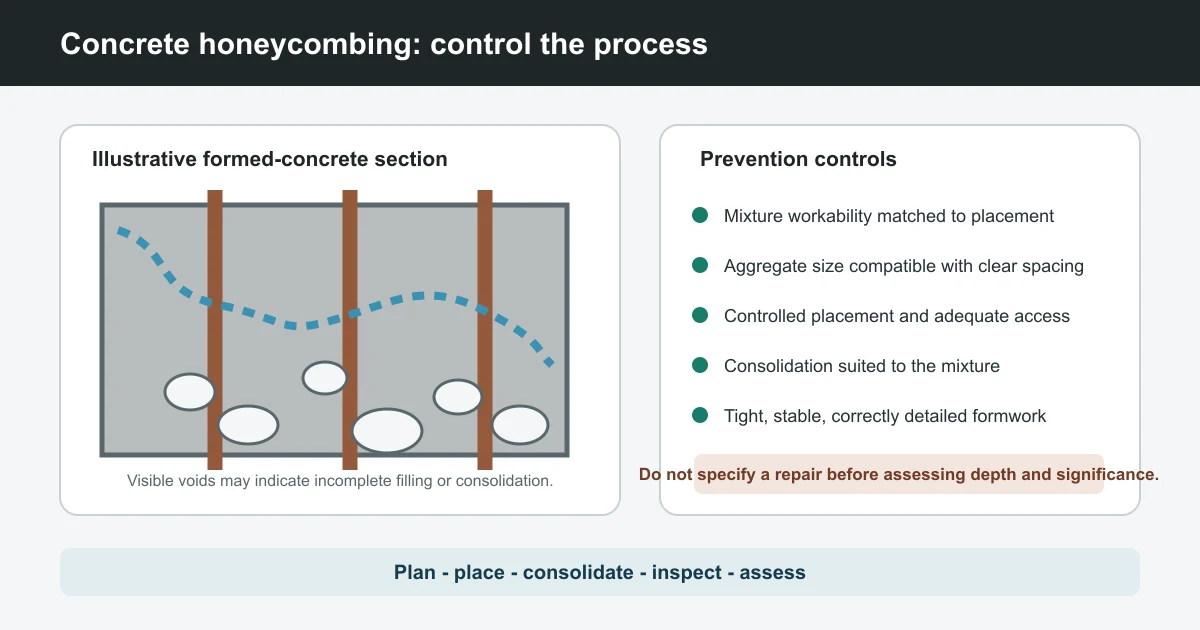
Honeycombing is visible voiding in formed concrete where mortar did not completely fill the space around coarse aggregate, reinforcement, embedded items, or the form surface. It is a symptom with several possible causes—not a repair specification by itself.
Why honeycombing matters
Minor surface voids and deep zones of poorly consolidated concrete are not equivalent. Depending on location, depth, connectivity, exposure, and member function, honeycombing may affect appearance, cover to reinforcement, permeability, durability, bond, or load transfer. The significance cannot be judged reliably from one photograph or from surface area alone.
Interacting causes
Mixture workability and stability
A mixture that cannot flow through the available clear spacing or respond to the selected consolidation method may leave voids. A mixture can also be too unstable: segregation separates coarse aggregate from mortar and makes uniform filling harder. Water should not be added as an uncontrolled response; the mixture, admixture system, moisture corrections, temperature, elapsed time, and approved workability range must be evaluated together.
Aggregate size and clear spacing
Nominal maximum aggregate size must be compatible with the space between reinforcement, embedded items, forms, and placement openings. Congested details can block coarse aggregate and create local mortar loss even when the delivered concrete appears workable.
Placement access and sequence
Long uncontrolled drops, placing from one inaccessible point, excessive horizontal movement, blocked placement paths, or lifts that cannot be consolidated can create rock pockets and incomplete filling. The placement plan must match the geometry and congestion of the member.
Consolidation method
Internal vibration must be suited to the mixture, element, formwork, reinforcement, and placement rate. Inadequate coverage, poor insertion access, failure to connect adjacent lifts, or withdrawing the vibrator before air is released can leave voids. Excessive or inappropriate vibration can increase segregation risk. Self-consolidating concrete follows a different placement and verification approach and may not require conventional vibration.
Formwork and leakage
Joints, penetrations, corners, and interfaces must be sufficiently tight and stable. Loss of paste or mortar through openings can leave coarse aggregate exposed. Form pressure, release agent, cleanliness, movement, and access for observation also affect the result.
Production and timing
Incorrect aggregate moisture correction, batching error, delayed discharge, temperature, unexpected slump loss, admixture incompatibility, or inconsistent mixing can reduce the placement window. Production, delivery, and site records are therefore part of the investigation.
Assessment before repair
- Secure the situation. If structural stability, falling material, exposed reinforcement, prestressing, or public safety may be involved, restrict access and obtain the appropriate responsible professional’s assessment.
- Record location and extent. Map the affected member, face, elevation, dimensions, reinforcement relationship, construction joint, and exposure. Use photographs with scale and dates.
- Distinguish surface appearance from depth. Sounding, carefully controlled removal, non-destructive testing, cores, or other investigation may be needed. Method selection belongs to the project team.
- Review traceable records. Mixture ticket, aggregate moisture, added water, admixture dosage, concrete and ambient temperature, delivery time, slump or flow, air, placement sequence, lift depth, vibrator type and access, crew observations, and formwork condition can help test competing explanations.
- Assess significance. Consider member function, cover, reinforcement bond, section loss, exposure, leakage path, durability, structural demand, and the reliability of the evidence.
- Define acceptance and repair criteria. The responsible design and project parties determine whether to accept, investigate further, repair, strengthen, or replace.
A prevention framework
- Plan: review congestion, access, openings, lift sequence, backup equipment, inspection points, and stop criteria before placement.
- Match the mixture: validate workability, cohesion, aggregate size, retention, and consolidation response with representative materials and conditions.
- Control the batch: maintain current moisture corrections, approved admixture dosage and sequence, temperature controls, and traceable adjustments.
- Prepare the forms: confirm cleanliness, tightness, stability, penetrations, release agent, and safe access.
- Place deliberately: maintain a controlled supply and place close enough to the final position to avoid segregation and unplanned movement.
- Consolidate systematically: select equipment and coverage based on the actual mixture and geometry; ensure adjacent zones and lifts are connected without contacting reinforcement or forms in a damaging way.
- Observe: watch accessible surfaces, corners, joints, and form leakage; stop and correct the process when warning signs appear.
- Inspect after stripping: record defects before cosmetic treatment hides their extent.
Repair is a separate engineering decision
A repair procedure should follow assessment. It normally needs defined removal limits, confirmation of sound substrate, reinforcement treatment where applicable, surface preparation, repair-material compatibility, placement method, curing, dimensional and appearance requirements, and verification. A thin cosmetic coating can conceal a deeper defect without restoring the required performance.
Repair materials also have their own shrinkage, stiffness, bond, thermal, permeability, installation, and curing behaviour. Product selection without a defined defect and performance requirement is not a complete repair design.
Questions for a root-cause review
- Was the defect local to a congested or inaccessible detail?
- Did it align with a lift, construction joint, form joint, penetration, or leakage path?
- Were aggregate size and mixture workability compatible with clear spacing?
- Were delivered and placed properties measured with comparable methods and timing?
- Was the supply continuous enough for the planned lift and consolidation sequence?
- Could the vibrator reach every zone, and was its operation appropriate for the mixture?
- Did form movement or paste leakage occur?
- Do production and site records show a change point?
- What evidence establishes the defect depth and significance?
Authoritative references
- American Concrete Institute — honeycombing and consolidation FAQ
- American Concrete Institute — Honeycomb Surfaces for Concrete topic resources
- American Concrete Institute — nominal maximum aggregate size and clear spacing
- American Concrete Institute — purpose and methods of consolidation
- American Concrete Institute Committee 309 — Consolidation of Concrete
- ACI 309R preview — Guide for Consolidation of Concrete
- American Cement Association — working with concrete