Technical Notice: This article provides general technical information, not a product design, installation specification, structural assessment, or repair instruction. Acceptable flatness, curvature, cracking, movement, support, jointing, reinforcement, curing, storage, and testing must be defined for the actual product and governing documents. Thin or load-bearing units should be evaluated by qualified professionals using representative materials, dimensions, production conditions, and exposures.
Warping and curling are out-of-plane deformations: a tile, panel, or slab no longer remains as flat as intended. The edges or corners may rise, the center may lift, or the curvature may reverse as temperature and moisture conditions change. The visual symptom is simple, but the cause is not. Geometry, drying, thermal exposure, restraint, support, mixture proportions, curing, storage, and installation can all contribute.
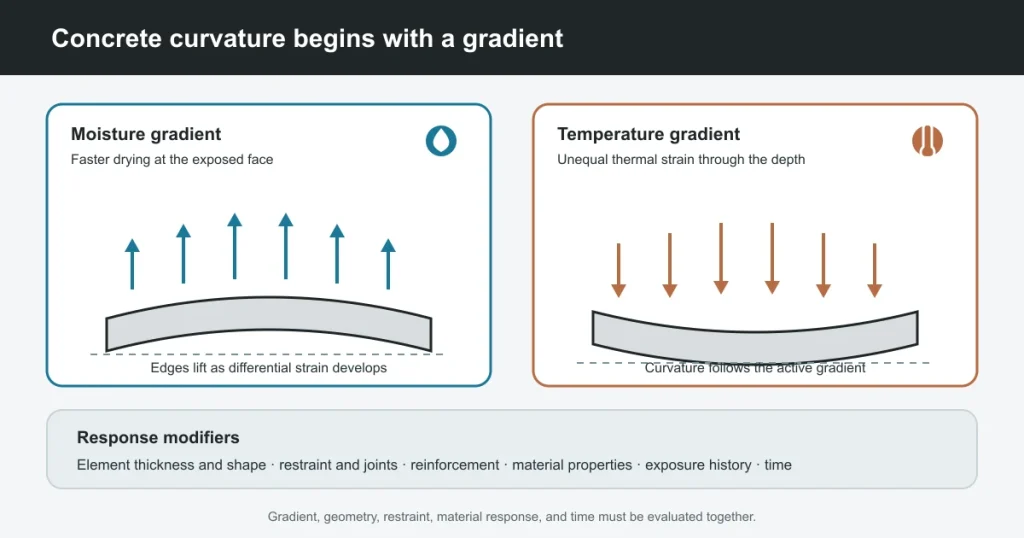
ACI Concrete Terminology distinguishes the mechanisms when they act independently: temperature differentials produce curling, while moisture differentials produce warping. In practice, both effects often act together, and project teams frequently use “curling” as the broader label. The important task is not choosing a label; it is identifying the gradient, the restraint, and the time at which deformation developed.
Why a gradient bends concrete
Concrete changes length as its temperature and moisture condition change. If both faces of a free, uniform element change by the same amount, the element can shorten or lengthen without developing curvature. If one face changes more than the other, the difference through the thickness creates curvature.
For example, the exposed face of a newly cast tile may dry before the mould face. The drier face tends to shorten first, so the tile curves toward that face. An exterior unit heated by sunlight may have a warmer face and a cooler back; the thermal strain difference can bend the unit in the opposite direction. The response depends on the sign and magnitude of the gradient, the element thickness and stiffness, creep, age, and restraint.
Restraint converts free movement into stress. A tile bonded to a substrate, a slab supported unevenly, or a panel fixed at discrete points cannot move as a free laboratory specimen would. Curvature may therefore appear with cracking, debonding, rocking, joint distress, or local bearing damage.
Moisture-driven warping
Moisture conditions are rarely symmetric through a concrete product. Common sources of differential drying or wetting include:
- one face exposed to air while the opposite face remains against a mould, pallet, membrane, or moist substrate;
- unequal curing between faces or early removal of moisture protection;
- stacking that shelters some surfaces and exposes others;
- wet installation mortar or grout behind a relatively dry tile;
- rain, wash water, or ground moisture reaching one face; and
- coatings or sealers that change the drying rate of only one surface.
Drying shrinkage is affected by the paste system, total water, aggregate volume and stiffness, constituent properties, curing, relative humidity, and element size. A lower water–cementitious materials ratio (w/cm) does not automatically mean lower shrinkage. If a low w/cm is achieved by increasing cementitious material content rather than reducing water and paste volume, shrinkage and curling potential may increase. ACI’s guidance on slab curling makes this distinction explicit.
Temperature-driven curling
Thermal curvature can change over a day or season. Solar heating, cold air, contact with a cooler base, accelerated curing, hot forms, steam exposure, and uneven cooling can create through-thickness temperature differences. Thin elements respond quickly; thicker elements may sustain a gradient for longer.
Early-age thermal effects require particular care. Hydration generates heat while concrete stiffness and tensile capacity are developing. Rapid or asymmetric heating and cooling can combine with drying and restraint. A single surface-temperature reading cannot establish the gradient; measurements should represent both faces and, when relevant, the interior.
Other contributors that can look like warping
Not every non-flat tile is caused by a moisture or temperature gradient. A useful investigation also considers:
- a distorted, flexible, or unlevel mould;
- uneven support during demoulding, handling, storage, or transport;
- thickness variation or eccentric reinforcement;
- segregation, bleeding, or nonuniform consolidation;
- local repair, surface treatment, or grinding;
- differential autogenous shrinkage in low-w/cm systems;
- incompatible substrate movement or adhesive shrinkage;
- overload, impact, or lifting from the wrong points; and
- dimensional change from a separate deterioration mechanism.
The time history is valuable evidence. Deformation visible immediately after demoulding points to different causes than curvature that appears only after dry storage or only after installation.
Prevention begins with a measurable requirement
“Must remain flat” is not a testable production requirement. Define the permitted deviation, measurement method, support condition, age, temperature, moisture conditioning, sampling frequency, and disposition of nonconforming units. A tile measured warm on a mould and the same tile measured after conditioning on three supports are not directly comparable.
Representative prototypes should use the intended dimensions, reinforcement, surface finish, curing, demoulding time, lifting points, packaging, storage orientation, and installation system. Small laboratory specimens may help compare mixtures, but they do not reproduce every gradient or restraint in a full-size unit.
Mixture and material controls
A low-distortion mixture is a coordinated balance, not a single ingredient change.
- Control total water and paste volume. Use only the water needed for verified production and finishing. Do not reduce workability to the point that consolidation becomes unreliable.
- Use aggregate effectively. Aggregate grading, nominal maximum aggregate size, volume, stiffness, absorption, and dimensional stability affect shrinkage and restraint. Size must remain compatible with product thickness, reinforcement, clear spacing, and finish.
- Qualify the cementitious system. Supplementary cementitious materials may change water demand, setting, heat evolution, strength development, and shrinkage. Their effect must be established with the actual combination and curing regime.
- Evaluate admixture interactions. Water reducers, viscosity-modifying admixtures, shrinkage-reducing admixtures, and other products can be useful, but performance is mixture-specific. Dosage should follow supplier guidance and trials.
- Compare length change under controlled conditions. ASTM C157/C157M can support comparative evaluation of laboratory mixtures, but its result is not a direct prediction of full-size tile curvature.
Internal curing is a defined approach that supplies curing water from internal reservoirs, commonly prewetted lightweight aggregate. It should not be assumed that an arbitrary polymer addition is an internal-curing system. Any proposed product needs a documented mechanism, compatibility evidence, and representative trials.
Production, curing, and storage controls
Symmetry is a useful production principle. Keep mould support uniform, maintain consistent thickness, and avoid localized heat or airflow. After finishing, protect exposed surfaces promptly and cure in a way that limits unequal moisture loss and harmful temperature gradients. Record concrete temperature, ambient conditions, curing start and end times, and deviations.
Demoulding should be based on verified handling strength and product behavior, not the clock alone. Use lifting points and frames that prevent unintended bending. Support freshly demoulded units on a flat, stable system; stacking points should align vertically and distribute load as intended.
During storage, expose faces as uniformly as practical. Packaging that seals one face and vents the other can create a new gradient. If units will be installed in a different climate, define conditioning and acclimation rather than moving them directly from one extreme environment into another.
Installation matters as much as production
An acceptably flat tile can distort after installation. Check the substrate for flatness, stiffness, moisture, temperature, and movement. The adhesive or bedding system must be compatible with the unit, substrate, joints, exposure, and service loads. Full, uniform support is generally preferable to isolated contact points unless the engineered system requires otherwise.
Movement joints, perimeter clearances, panel joints, anchors, and sealants must accommodate the expected movements. Applying a coating or membrane to only one face changes moisture exchange and should be evaluated as part of the complete assembly.
A diagnostic workflow for distorted units
- Record unit ID, batch, dimensions, reinforcement, production time, mould, curing, demoulding, storage, transport, and installation history.
- Map curvature using a defined datum and repeatable support condition. Note whether it changes after turning the unit over or changing temperature.
- Measure temperature and moisture conditions on both faces over time; do not rely on one reading.
- Check thickness, support, joints, bond, voids, and substrate movement.
- Compare affected and unaffected units from the same and different batches.
- Review mixture records, total water, authorized adjustments, aggregate moisture corrections, admixture dosage, and curing logs.
- Select tests to discriminate between hypotheses. Do not core or load-test thin units without an approved plan.
- Decide whether the issue is cosmetic, serviceability-related, bond-related, or structural before choosing a repair.
Grinding a high corner, forcing a warped tile flat, or injecting adhesive may transfer stress or conceal the cause. Repair and acceptance should follow an engineering assessment of the complete assembly.
Frequently asked questions
Is lower w/cm always the best way to prevent curling?
No. w/cm is important for many properties, but shrinkage and curvature also depend on total water, paste volume, aggregates, curing, geometry, and restraint. Lowering w/cm by adding cementitious material can increase paste volume and may not reduce curling.
Can a warped concrete tile become flat again?
Some curvature changes when moisture or temperature gradients reverse, but recovery may be incomplete. Cracking, creep, bond loss, or permanent deformation can remain. Diagnose the cause and service consequence before attempting correction.
Does high compressive strength guarantee dimensional stability?
No. Compressive strength does not directly define drying shrinkage, thermal response, creep, support, or through-thickness gradients. Dimensional stability needs its own performance criteria and verification.
Related reading
- Concrete Curing Methods: Controlling Moisture and Temperature
- Concrete Durability: Exposure, Transport, Materials, and Execution
- Request a technical consultation
Technical references
- American Concrete Institute, ACI CT-25: ACI Concrete Terminology: https://www.concrete.org/portals/0/files/pdf/ACI_Concrete_Terminology.pdf
- National Ready Mixed Concrete Association, CIP 19—Curling of Concrete Slabs: https://www.nrmca.org/wp-content/uploads/2021/01/19pr.pdf
- American Concrete Institute, ACI PRC-302.1-15—Guide to Concrete Floor and Slab Construction: https://www.concrete.org/topicsinconcrete/topicdetail/CURLING?search=CURLING
- American Concrete Institute, ACI PRC-360-10—Guide to Design of Slabs-on-Ground: https://www.concrete.org/store/productdetail.aspx?Format=PROTECTED_PDF&ItemID=36010&Language=English&Units=US_AND_METRIC
- American Concrete Institute, Concrete Q&A: Curling, shrinkage, and w/cm: https://www.concrete.org/frequentlyaskedquestions.aspx?faqid=852
- ASTM International, ASTM C157/C157M-24e1—Length Change of Hardened Hydraulic-Cement Mortar and Concrete: https://www.astm.org/membership-participation/technical-committees/committee-c09/subcommittee-c09/jurisdiction-c0968