
Technical Notice: This article provides general technical guidance, not a project specification. The required curing method, start time, duration, temperature limits, acceptance criteria, and verification plan must come from the contract documents, the applicable code and specification framework, the concrete mixture and exposure conditions, and qualified project professionals. Product application must also follow the current manufacturer instructions. No single curing period or temperature threshold is appropriate for every concrete placement.
Concrete curing is a controlled construction process that maintains moisture and temperature conditions so a newly placed cementitious mixture can develop its intended strength, surface quality, permeability, appearance, and durability. It begins with protection against premature surface drying and ends only when the governing requirements permit the controls to be removed.
What curing must control
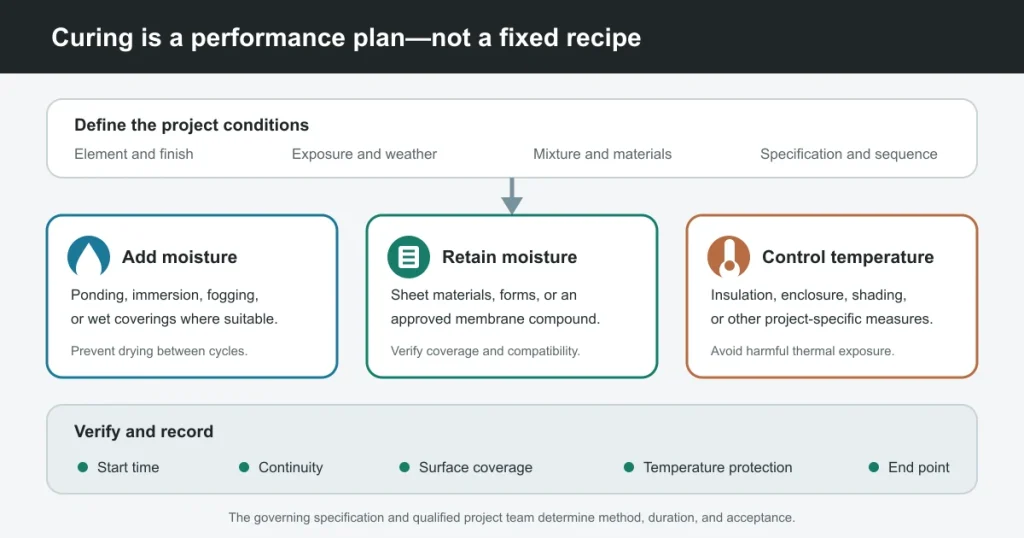
Hydration and, where applicable, pozzolanic reactions depend on the availability of moisture and a suitable temperature history. ACI defines curing as action taken to maintain those conditions so that the potential properties of the mixture can develop.[1] The practical curing plan should control four connected variables:
- Moisture availability. The surface and near-surface concrete must not lose moisture faster than the curing system can replace or retain it.
- Temperature. The concrete must be protected from freezing, excessive heating, rapid cooling, and harmful temperature differences within the member.
- Timing. Initial protection and final curing should begin at the appropriate stage without damaging the surface or interfering with finishing.
- Continuity. Gaps, dry intervals, torn sheets, incomplete compound coverage, exposed edges, and premature removal can defeat an otherwise suitable method.
The exposed surface is often the most vulnerable zone. Poor curing can appear first as dusting, crazing, reduced wear resistance, increased permeability, or shallow cracking even when the interior appears satisfactory.
Curing is not the same as pre-set evaporation control
Fogging or an evaporation retardant may reduce rapid moisture loss before final set and during finishing, but does not automatically constitute final curing. NRMCA CIP 11 distinguishes this early protection from the moist-curing or moisture-retention methods used afterward.[3]
Method family 1: supply moisture continuously
Water-based methods add water to the surface or keep a water-retaining material continuously wet. They can provide effective curing when water is available, temperatures are suitable, and the method can be maintained without interruption.
Continuous fogging or sprinkling
Fine fogging, sprinklers, or soaker hoses can maintain a wet surface on horizontal or vertical work. Coverage should be uniform without erosion, washout, or uncontrolled runoff. Intermittent wetting that allows the concrete or covering to dry is not continuous moist curing. Water and equipment must remain reliable, and wet curing may be unsuitable where freezing is possible.
Ponding
Ponding can maintain direct water contact on flat, contained surfaces. It requires sound edge dams, reliable water, leakage control, and consideration of the supporting layers. No universal pond depth should be assumed; the method statement should define how coverage will be maintained without contamination, surface damage, or undesirable thermal shock.
Saturated absorbent coverings
Burlap, cotton mats, or other approved absorbent coverings can retain water on horizontal or vertical surfaces. They should be clean, nonstaining, secured against wind, overlapped where necessary, and kept continuously wet. A covering that dries can draw moisture from the concrete rather than protect it.
Appearance requirements matter. Some materials can discolor architectural surfaces, leave texture marks, or introduce contaminants. A representative trial area is prudent when appearance is critical.
Forms retained in place
Formwork can reduce moisture loss from formed surfaces, but exposed tops, joints, corners, and surfaces uncovered after form removal still require protection. Form-removal timing remains governed by structural, safety, and project requirements.
Method family 2: retain the concrete’s moisture
Moisture-retention methods limit evaporation without requiring a continuous water supply. They include sheet materials and liquid membrane-forming curing compounds.
Sheet materials
Plastic film and waterproof curing paper are covered by ASTM C171-20, Standard Specification for Sheet Materials for Curing Concrete.[6] Specifying “plastic” alone is not enough; the selected sheet material should conform to the project requirement and be suitable for the intended exposure and finish.
Sheets should be placed without marring the surface and kept in close contact with the concrete. Laps, edges, penetrations, and terminations need secure closure; tears require prompt repair. Sheet color should respond to exposure because clear, dark, and reflective materials affect solar heat gain differently.
Wrinkles and uneven contact can create variations in moisture and temperature that leave visible marks. For exposed architectural concrete, the appearance risk should be evaluated before this method is selected.
Liquid membrane-forming curing compounds
The ASTM designations must be used correctly:
- ASTM C309-25 covers liquid membrane-forming compounds applied to concrete surfaces to reduce water loss during early hardening. The official scope also recognizes white-pigmented products for reducing temperature rise from solar radiation.[4]
- ASTM C1315-25 covers membrane-forming liquids used as curing compounds and sealers with additional properties such as resistance to ultraviolet degradation, acid and alkali exposure, and adhesion-related performance.[5]
These standards are not application instructions. The project specification and manufacturer data must establish the product, rate, surface condition, equipment, passes, drying protection, repair criteria, and inspection method.
Application is coordinated with final finishing and disappearance of free water sheen, before the surface dries. A fixed delay after placement is unreliable because bleeding, setting, finishing, weather, and mixture behavior vary.
Compatibility is a major selection issue. A curing compound may interfere with a later coating, topping, adhesive, sealer, or flooring system. The proposed product and any removal procedure should be accepted by the relevant material suppliers and project team before application. A compound should not be called an admixture: it is a surface-applied curing material.
Method family 3: manage temperature as well as moisture
Moisture control alone is insufficient when the concrete may freeze, overheat, cool rapidly, or develop a harmful internal-to-surface temperature difference. Temperature-control measures can include insulated blankets, enclosures, controlled heating, reflective protection, changes in placement timing, or monitored cooling.
The objective is not simply to make concrete warmer. Direct heat can dry the surface or create thermal gradients, and combustion heaters require ventilation and safety controls. Insulation should be removed without abrupt temperature change.
For thick sections, precast production, steam curing, or autoclaved products, the temperature cycle is a designed process. Heating, holding, cooling, moisture, and acceptance parameters must be established specifically; conventional guidance should not be used to invent an accelerated cycle.
How long should curing continue?
There is no universal answer. A calendar-only rule can be either insufficient or unnecessarily conservative because the required period is affected by:
- the project specification and applicable code;
- cementitious materials and mixture proportions;
- concrete temperature history and ambient exposure;
- member geometry and surface-to-volume ratio;
- required strength, durability, abrasion, or appearance performance;
- subsequent loading, form removal, coating, or construction operations; and
- the selected method’s demonstrated continuity and effectiveness.
NRMCA CIP 11 provides educational guidance but directs users to the project specification and recognizes that mixture and temperature conditions change the required period.[3] A nominal number of days or one strength percentage is not a universal criterion.
Where a performance-based end point is permitted, define it before placement. ACI notes that maturity can estimate in-place strength only when a time-temperature relationship has been established for the same mixture; cores may also verify in-place properties when appropriate.[2]
A practical curing-method decision framework
Use the following sequence before selecting a method:
1. Define the required outcome
Identify the curing provisions and relevant properties: strength, abrasion resistance, permeability, durability, coating bond, or appearance.
2. Characterize the concrete and member
Review the cementitious system, mixture proportions, setting and bleeding, member geometry, exposure, formwork, joints, edges, and finish.
3. Evaluate exposure during the curing window
Consider temperature, humidity, wind, solar radiation, precipitation, freezing risk, and the reliability of water, power, labor, and monitoring. ACI identifies air temperature, concrete temperature, relative humidity, and wind as evaporation-risk inputs.[2]
4. Check downstream compatibility
Confirm whether the surface will receive flooring, a coating, an adhesive, a repair material, or an architectural finish. Eliminate methods that can stain, mark, contaminate, or impair bond unless a validated removal process is included.
5. Define execution and verification
The method statement should state when protection begins, how continuity is maintained, who inspects it, how damage is repaired, what temperature or moisture records are required, and what authorizes termination.
| Placement condition | Candidate approach | Key control |
|---|---|---|
| Flatwork with reliable water and acceptable runoff | Ponding, continuous sprinkling, or wet coverings | Continuous moisture; no erosion, leakage, contamination, or damaging temperature change |
| Vertical or irregular surfaces | Soaker hoses with absorbent coverings, retained forms, or approved curing compound | Full edge and corner coverage; secure materials against displacement |
| Limited water availability | ASTM C171-compliant sheets or an approved membrane-forming compound | Sealed laps or verified compound coverage; rapid repair of damage |
| Solar exposure and heat gain | Reflective sheet or an accepted white-pigmented compound, combined with project temperature controls | Product compliance, uniform coverage, and monitored concrete temperature |
| Freezing or rapid-cooling risk | Enclosure, insulation, controlled heating, and moisture-retention curing | Prevent freezing, surface drying, combustion hazards, and abrupt temperature change |
| Surface scheduled for coating or bonding | Compatible curing system accepted by all relevant suppliers | Documented compatibility or validated removal before the next system is installed |
Field checklist
Before placement
- Confirm the governing curing specification and acceptance criteria.
- Approve the method, backup method, materials, equipment, staffing, and monitoring plan.
- Check curing-product certificates and current manufacturer instructions.
- Resolve compatibility with coatings, adhesives, toppings, sealers, and architectural finishes.
- Review weather forecasts and define triggers for added evaporation or temperature protection.
- Provide safe access to edges, vertical surfaces, joints, and repair areas.
During placement and finishing
- Monitor conditions that affect evaporation and temperature.
- Protect the surface from premature drying without adding finishing water improperly.
- Begin final curing at the correct surface condition without marring the concrete.
- Record the start time, method, product batch where applicable, and responsible inspector.
During curing
- Keep wet coverings continuously wet.
- Inspect sheets for contact, sealed laps, wind uplift, punctures, and exposed edges.
- Inspect curing compounds for uniform, complete coverage and repair missed areas.
- Monitor concrete temperatures where the specification or risk assessment requires it.
- Record interruptions, repairs, weather changes, and deviations.
Before termination
- Verify that the specified duration or approved performance criterion has been met.
- Remove water, sheets, insulation, or enclosures gradually when rapid drying or cooling is a concern.
- Confirm the surface is ready for the next construction operation.
- Document final condition, observed defects, test results, and acceptance.
Common curing failures to prevent
- waiting until the surface has already dried before starting protection;
- allowing wet coverings to dry between applications of water;
- leaving edges, corners, construction joints, or newly exposed formed surfaces untreated;
- using torn or poorly secured sheet materials;
- applying a curing compound at an unverified rate or over standing bleed water;
- selecting a membrane that is incompatible with a later bonded system;
- treating an evaporation retardant as the final curing method;
- heating the air while allowing the concrete surface to dry;
- removing insulation or protection abruptly; and
- ending curing only because a customary number of days has elapsed.
Frequently asked questions
What conditions should a concrete curing plan control?
It should control moisture availability, concrete temperature, the timing of initial and final protection, and continuity. Dry intervals, incomplete coverage, exposed edges, or premature removal can undermine an otherwise suitable method.
Do fogging and evaporation retardants count as final curing?
Not automatically. They can reduce premature moisture loss before final set or during finishing, but final curing still requires the approved moist-curing or moisture-retention system.
How should a curing method be selected?
Selection should consider the required performance, concrete mixture and member geometry, expected environment, available resources, appearance, compatibility with later coatings or bonded systems, and how execution will be verified.
How long should concrete curing continue?
There is no universal duration. The governing documents, cementitious system, temperature history, geometry, required properties, later construction operations, and continuity of the selected method determine the applicable end point.
How do ASTM C309 and ASTM C1315 curing materials differ?
ASTM C309 covers membrane-forming compounds primarily used to reduce early water loss, while ASTM C1315 covers curing-and-sealing liquids with additional performance properties. Neither standard replaces the project specification or the manufacturer’s application instructions.
Final perspective
Effective curing is a planned system for moisture retention, temperature management, continuity, and verification. Water curing, sheet materials, membrane-forming compounds, retained forms, insulation, and controlled heating can all be appropriate—but only when they match the member, mixture, environment, finish, and project requirements.
The best curing method is not the one that is easiest to name. It is the one that can be applied at the correct time, maintained without interruption, verified in the field, and terminated under a defined acceptance rule.
Authoritative references
- American Concrete Institute, “What is curing?” FAQ 789: https://www.concrete.org/frequentlyaskedquestions.aspx?faqid=789
- American Concrete Institute, “How can the effectiveness of curing be measured?” FAQ 802: https://www.concrete.org/frequentlyaskedquestions.aspx?faqid=802
- National Ready Mixed Concrete Association, CIP 11 — Curing In-Place Concrete: https://www.nrmca.org/wp-content/uploads/2021/01/11pr.pdf
- ASTM International, ASTM C309-25 — Standard Specification for Liquid Membrane-Forming Compounds for Curing Concrete: https://store.astm.org/c0309-25.html
- ASTM International, ASTM C1315-25 — Standard Specification for Liquid Membrane-Forming Compounds Having Special Properties for Curing and Sealing Concrete: https://store.astm.org/c1315-25.html
- ASTM International, ASTM C171-20 — Standard Specification for Sheet Materials for Curing Concrete: https://store.astm.org/c0171-20.html