Technical Notice: This article provides general technical information, not operating instructions, a vehicle-safety procedure, or authority to adjust concrete. Truck capacity, loading, drum speed, mixing, discharge, washout, water or admixture addition, sampling, acceptance, and road operation must follow the equipment manufacturer, current contract documents, applicable standards, producer procedures, and authorised personnel. Never enter a drum or work near moving equipment without the required lockout and safety controls.
A concrete truck mixer is more than a vehicle with a rotating drum. It is the final controlled stage of a ready-mixed concrete production and delivery process. The unit may complete mixing, agitate centrally mixed concrete during transport, remix authorised additions, and discharge at a controlled rate. Modern fleets can also record drum revolutions, speed, location, time, water or admixture additions, and other delivery data.
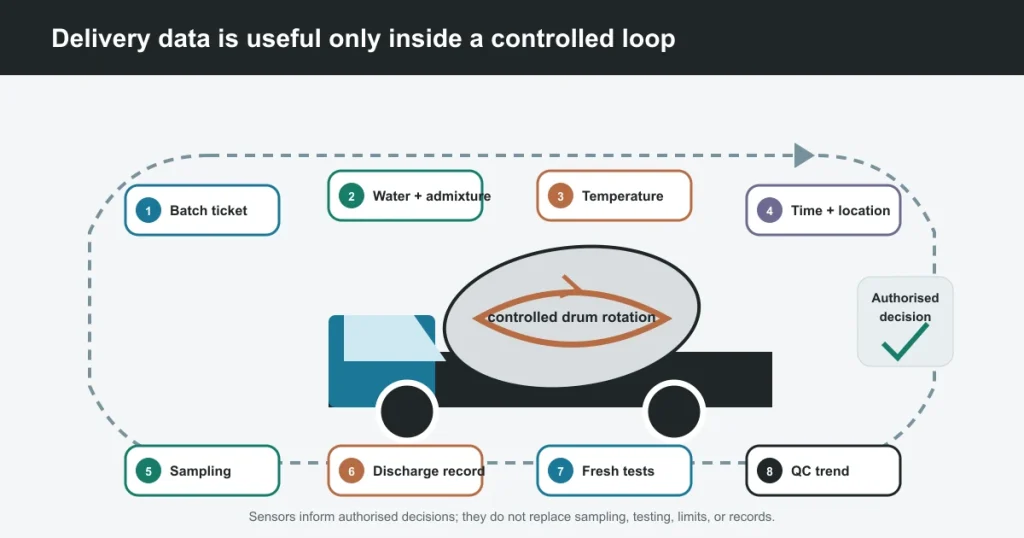
Technology improves visibility, but it does not automatically improve concrete. Sensors must be calibrated, algorithms must be validated for the actual mixtures, adjustments must remain within the approved water and admixture limits, and people must act on the data.
Truck mixer, agitator, and volumetric mixer are different
ASTM C94/C94M covers ready-mixed concrete manufactured and delivered fresh, using stationary mixers, truck mixers, or truck agitators as applicable. A truck mixer can mix concrete within its rated capacity. A truck agitator maintains previously mixed concrete in an agitated state but is not necessarily rated to perform the full mixing function.
A volumetric-measuring and continuous-mixing unit stores constituent materials separately and proportions and mixes them at discharge. That equipment follows a different production concept and is covered by other requirements, including ASTM C685/C685M where specified. It should not be described as a conventional drum mixer.
Main components of a drum truck mixer
Drum and mixing blades
The drum and internal helical blades move concrete differently depending on rotation direction and speed. In one direction, the blades carry material into the drum for mixing or agitation; in the other, they move concrete toward the discharge opening. Wear, hardened buildup, damaged blades, and excessive loading reduce effective mixing and discharge performance.
The Truck Mixer Manufacturers Bureau rating plate and producer inspection records establish the unit’s rated mixing and agitating capacities and recommended speeds. Gross drum volume is not the same as rated concrete capacity.
Drive and control system
Hydraulic or other drive systems rotate the drum. Controls may display direction, speed, and revolution count. Some fleets integrate automatic transitions between mixing and agitation speeds, but manufacturer limits and producer procedures remain authoritative.
Charging, discharge, and chute system
The charging hopper, discharge opening, main chute, and extension chutes should be clean, sound, and positioned safely. Rear-discharge and front-discharge trucks differ in manoeuvring and chute control, but both require a stable access plan, exclusion zones, communication, and protection from overhead and ground hazards.
Water and admixture equipment
On-board water systems can serve washdown and, when specifically authorised, measured adjustment. Some trucks also carry metered admixture systems. Tanks, meters, pumps, valves, nozzles, lines, and interlocks require inspection and calibration. A displayed quantity is not evidence of accuracy unless the complete measurement system is verified.
Mixing, agitation, and discharge
Concrete may be:
- truck mixed, with constituents charged at the plant and mixing completed in the truck;
- shrink mixed, with partial mixing in a stationary mixer and completion in the truck; or
- central mixed, with full mixing before loading and agitation during delivery.
The required revolutions and speed depend on the production method, mixer qualification, manufacturer guidance, and project documents. Counted revolutions should distinguish mixing speed from agitation speed where the procedure requires it.
Discharge rate must match the placing system and crew capacity. Prolonged stops, intermittent discharge, or repeated speed changes can affect consistency, air, temperature, and uniformity. The team should coordinate truck arrival, access, pump or chute setup, sampling, placement, consolidation, and curing before dispatching the load.
Fresh concrete changes during delivery
Ready-mixed concrete is time- and temperature-sensitive. Hydration, absorption, evaporation, mixing, agitation, air system, admixture response, and weather can change measured consistency and other fresh properties. Slump loss is not direct proof that a known mass of water has evaporated, and a target slump should not be maintained by uncontrolled water addition.
The current ASTM C94/C94M-26b and the project specification govern delivery and discharge requirements. Do not copy a legacy “90 minutes or 300 revolutions” rule without checking the current contract and standard edition. Mixture qualification, temperature, set-control technology, haul conditions, and purchaser requirements can affect the accepted delivery window.
In-transit monitoring and telematics
Modern systems can combine:
- dispatch order and mixture identification;
- plant departure, route, arrival, and discharge times;
- geographic location and estimated arrival;
- drum direction, speed, and revolutions;
- concrete or ambient temperature sensors;
- water and admixture meter events;
- hydraulic pressure, torque, or other signals used by an algorithm;
- electronic delivery ticket data; and
- alerts for delay, unauthorised addition, or deviation from a rule.
These records improve traceability and coordination. They can help a quality team identify a delayed load, confirm that remixing occurred after an addition, or compare field test timing with actual discharge.
However, indirect signals are not automatically standard test results. An estimated slump derived from drum torque or hydraulic pressure can be influenced by load size, drum condition, speed, temperature, mixture rheology, road slope, and calibration. Validate each mixture family and operating range against properly sampled field measurements, then monitor drift.
Controlled water and admixture adjustments
Any jobsite or in-transit adjustment needs an approved decision rule. The process should answer:
- Who is authorised to approve the addition?
- What remaining water and admixture limits apply?
- Which measured property and target range justify the adjustment?
- How is the quantity measured and recorded?
- What remixing is required after the addition?
- When and where is the acceptance sample taken?
- What happens if the limit is exceeded or the property remains outside tolerance?
Water added for cleaning is not available for mixture adjustment, and wash water must not enter the load unintentionally. The total water calculation should account for batch water, aggregate surface moisture, liquid admixture water where required, ice, and all authorised additions.
Admixture redosing can be effective for some mixtures but may change setting, air, segregation resistance, strength development, and finishing. Use supplier guidance and representative trials. A system that adds water or admixture automatically needs interlocks, verified limits, calibration, event logging, and a manual exception process.
Temperature control: monitor first, claim cautiously
Truck-mounted sensors can track concrete temperature, but measurement location and sensor response should be validated. The standard acceptance temperature is determined using the specified test method at the required sampling point—not merely from a dashboard value.
Concrete temperature is mainly managed through constituent temperatures, plant operations, scheduling, haul duration, protection, and placement planning. Ice or liquid nitrogen may be used in specialised production systems under engineered procedures, but a generic truck mixer should not be assumed to heat or cool the load automatically during transit. Any such equipment requires manufacturer documentation, hazard controls, mixture validation, and project approval.
Delivery tickets and data integrity
A useful electronic ticket connects the load to the approved mixture and production record. Depending on the governing requirements, information may include producer, plant, truck, ticket number, purchaser, project, mixture designation, batch quantities, water limits, batch time, load size, admixtures, and additions.
Digital records should preserve:
- timestamps and time zone;
- units and sensor identifiers;
- calibration status;
- who approved each change;
- original and corrected values;
- reason codes and comments;
- offline behaviour and later synchronisation; and
- retention, access, and cybersecurity rules.
A clean dashboard can still contain incomplete or misaligned data. Periodically reconcile tickets, batch records, truck events, field samples, laboratory results, and nonconformance reports.
Inspection and maintenance
NRMCA’s plant and truck certification resources identify important vehicle checks, including drum condition, blade wear, charging and discharge openings, rating information, revolution counters, and water-measurement equipment. A fleet program should also address chutes, guards, emergency stops, lighting, cameras, tyres, brakes, hydraulic leaks, and washout systems under the applicable vehicle rules.
Hardened concrete buildup reduces capacity and can detach. Removal can involve confined-space, impact, silica-dust, noise, falling-material, and stored-energy hazards. Use approved specialist procedures; never treat drum entry as routine cleaning.
A quality-control workflow
- Confirm approved order, mixture, quantity, site access, placing rate, and weather plan.
- Inspect truck readiness and verify current calibration status.
- Charge within rated capacity and complete required mixing.
- Record departure and monitor delay, drum state, temperature trend, and authorised events.
- At site, confirm ticket, access, discharge method, and safe communication.
- Evaluate consistency using the specified sampling and test methods.
- Make only authorised, measured adjustments within the approved limits; remix and record.
- Sample after the required mixing and at the specified point.
- Coordinate continuous discharge and placement without harmful segregation or delay.
- Close the ticket with quantities, times, additions, rejections, returns, and exceptions.
- Review exceptions and feed lessons into dispatch, mixture qualification, maintenance, and training.
Frequently asked questions
Can a truck sensor replace a slump test?
Only if the governing documents allow it and the measurement system has been validated for the relevant mixtures and conditions. An algorithmic estimate and a standard field test are not automatically equivalent.
Is adding water at the jobsite always prohibited?
No, but it must be authorised, measured, within the approved total-water and specification limits, followed by required remixing, and documented. Uncontrolled addition is unacceptable.
Does a newer truck guarantee better concrete?
No. Concrete quality still depends on materials, batching, mixture qualification, equipment condition, calibration, delivery planning, authorised decisions, placement, consolidation, curing, and verification.
Related reading
- Slump Loss in Ready-Mixed Concrete: Causes and Control
- Hot-Weather Concrete: Mechanisms, Risks, and Project Controls
- Water-Reducing Admixtures in Concrete
Technical references
- ASTM International, ASTM C94/C94M-26b—Standard Specification for Ready-Mixed Concrete: https://store.astm.org/c0094_c0094m-26b.html
- American Concrete Institute, ACI PRC-304-00 (Reapproved 2009)—Guide for Measuring, Mixing, Transporting, and Placing Concrete: https://www.concrete.org/store/productdetail.aspx?Format=DOWNLOAD&ItemID=30400&Language=English&Units=US_AND_METRIC
- American Concrete Institute, Committee 304—Measuring, Mixing, Transporting, and Placing Concrete: https://www.concrete.org/getinvolved/committees/directoryofcommittees/acommitteehome.aspx?committee_code=C0030400
- National Ready Mixed Concrete Association, Plant and Truck Certification Program: https://www.nrmca.org/certifications/plant-and-truck-certification-program/
- National Ready Mixed Concrete Association, Truck mixer vehicle inspection criteria: https://www.nrmca.org/wp-content/uploads/2020/01/Section5VehicleInspection.pdf
- ASTM International, User’s Guide to ASTM C94/C94M on Ready-Mixed Concrete: https://store.astm.org/mnl49-2nd-eb.html