Slump loss is a change in measured consistency over elapsed time. It is not, by itself, a direct measurement of water content. Effective control starts by confirming the initial condition, test comparability, temperature, aggregate moisture, materials, admixture response, transport, and placement timeline.
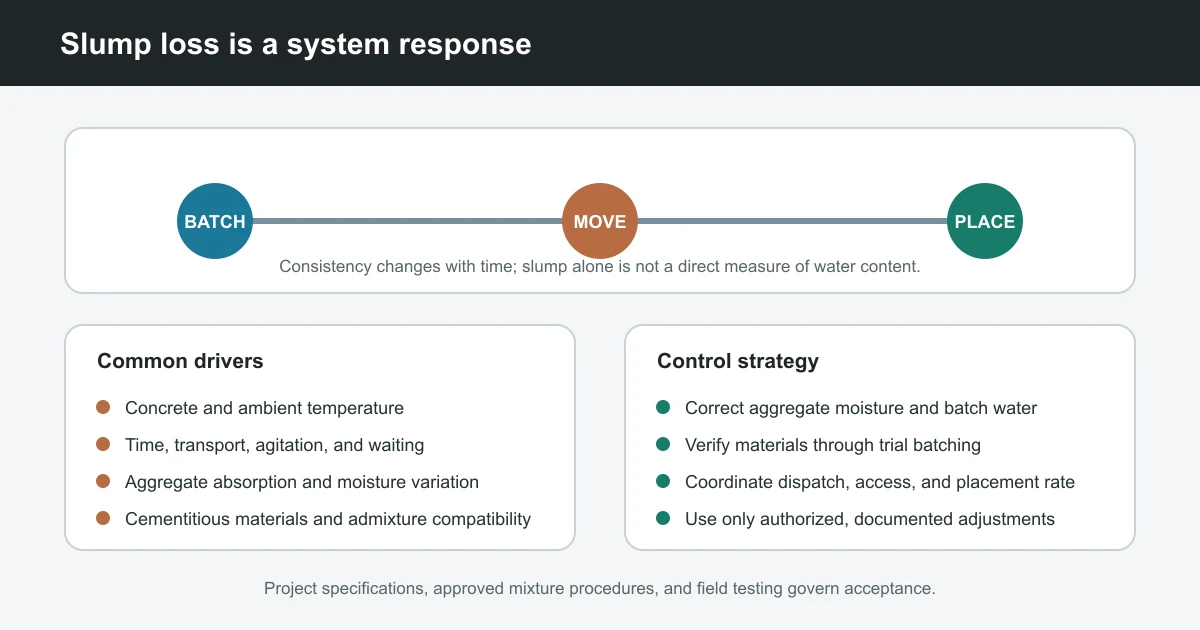
Define the problem before changing the concrete
Several different situations are often called “slump loss”:
- Low initial slump: the concrete never reached the intended initial consistency.
- True time-related loss: comparable measurements show a progressive reduction after mixing.
- Testing difference: sampling location, elapsed time, remixing, procedure, equipment, or operator changed.
- False or early stiffening: the mixture appears to lose workability through a material interaction that may respond differently to remixing.
- Loss of cohesion or air: the measured slump may change while stability, air, or finishability changes in another direction.
- Placement mismatch: the delivered property may meet the requirement, but access, pumping, congestion, waiting, or placement rate creates a different operational problem.
A useful investigation records the time and condition at every comparable observation rather than relying on one value at discharge.
Common interacting drivers
Elapsed time and temperature
Hydration and physical interactions continue after water contacts the cementitious materials. Higher concrete temperature generally accelerates the processes that reduce workability and can shorten the available placing window. Ambient conditions also affect haul, waiting, evaporation, equipment, and placement.
Aggregate absorption and moisture correction
Aggregate below SSD can take up part of the mixing water. Wet aggregate contributes surface water. A stale or incorrect moisture correction can shift both initial consistency and later retention. Each aggregate fraction must be corrected on a consistent basis.
Cementitious system and admixture compatibility
Cement composition and fineness, supplementary cementitious materials, temperature, sulfate balance, water-reducing admixture chemistry, dosage, addition time, and mixing energy interact. A product that performs well in one system or at one temperature is not automatically transferable to another.
Batching sequence and mixing
When water, cementitious materials, aggregates, and admixtures enter the mixer—and how long and intensely they are mixed—can change dispersion and retention. Plant and laboratory trials are comparable only when sequence, mixing, temperature, and timing are controlled.
Transport, agitation, and waiting
Haul time, drum operation, traffic, queueing, pump setup, access, and interruption extend elapsed time and can add variability. A mixture cannot compensate indefinitely for an uncontrolled delivery and placement process.
Water, air, and authorised adjustments
Adding water can increase slump, but it can also change water–cementitious materials ratio, strength, durability, bleeding, segregation, set, yield, and compliance. Any site adjustment must be allowed by the project requirements, remain within the approved limit, be measured and recorded, and be followed by the required remixing and testing. Unrecorded water is not a slump-retention strategy.
A disciplined diagnostic sequence
- Confirm the requirement. Record the specified property, test method, sampling point, permitted range, temperature limit, elapsed-time condition, and authority for adjustments.
- Verify the test. Compare equipment, sample, remixing, procedure, operator, time, and concrete temperature. Do not compare unlike measurements.
- Establish the initial condition. If the first valid result is already low, investigate batching, yield, moisture, admixture, and measurement before calling the problem retention.
- Build the timeline. Record batching, departure, arrival, sampling, adjustments, pump or placement start, interruptions, and final discharge.
- Check production records. Review actual material masses, moisture corrections, water sources, admixture dosage and sequence, mixing, temperature, and changes in material source or certificate data.
- Compare stable and affected loads. Look for the earliest change point across materials, weather, crew, equipment, route, and site operations.
- Run controlled trials. Reproduce representative temperature and elapsed times while changing one defined variable at a time.
- Verify the complete performance. Retention must not be improved at the expense of stability, air, setting, strength, durability, finishability, or project compliance.
Control strategies
- Keep aggregate moisture measurements and batch corrections current.
- Reduce unnecessary delay and coordinate dispatch, access, pump setup, placement rate, and backup planning.
- Control concrete temperature using project-approved measures and evaluate retention at realistic temperatures.
- Validate admixture type, dosage, addition sequence, and redosing procedure with the actual cementitious system and manufacturer guidance.
- Use representative trial batches that include the expected retention interval, mixing sequence, and acceptance tests.
- Define who may authorise water or admixture adjustments, the permitted limit, required remixing, records, and retesting.
- Trend data by material source, temperature, elapsed time, dosage, moisture result, and route rather than treating every event as isolated.
Designing a retention trial
A useful trial is a time series, not a single initial result. The plan should define:
- reference and candidate mixtures;
- actual material sources and moisture basis;
- batch size, mixing sequence, and mixing energy;
- concrete and ambient temperature ranges;
- sampling and remixing procedure;
- measurement intervals matched to expected transport and placement;
- slump or flow, air, temperature, density or yield, stability observations, setting, and relevant strength or durability checks; and
- predefined acceptance and stop criteria.
The number and timing of measurements must be selected for the project. Results from a different temperature, cementitious source, scale, or sequence should not be treated as automatically equivalent.
What not to conclude from slump alone
- Slump does not directly reveal the total water content.
- The same slump does not prove equal water–cementitious materials ratio.
- A higher slump does not necessarily mean better pumpability or finishability.
- A retained slump does not prove stability, air, set, strength, or durability compliance.
- A failed field result does not identify the cause without traceable production and test evidence.
Authoritative references
- National Ready Mixed Concrete Association — TIP 12: Slump Loss of Concrete
- American Concrete Institute — Hot Weather Concrete topic resources
- American Concrete Institute — concrete temperature in hot weather
- American Concrete Institute — set-controlling admixtures
- American Concrete Institute — hot-weather concreting guidance overview
- ASTM International — ASTM C494/C494M-24, Chemical Admixtures for Concrete
Field-review checklist
- Are the initial and later tests genuinely comparable?
- Are batching, arrival, test, adjustment, and discharge times recorded?
- Are concrete temperature and aggregate moisture current?
- Are all water sources and admixture additions measured and traceable?
- Did a material, sequence, plant, route, crew, or placement condition change?
- Does the trial reproduce the actual retention interval and temperature?
- Are stability, air, setting, strength, and durability checked alongside slump?