Technical Notice
This article provides general technical information. Project specifications, current standards, product data, and the decisions of the responsible parties govern. Select the product, dosage, addition sequence, and acceptance criteria through documented testing with the actual cementitious materials, aggregates, water, admixtures, production equipment, temperature range, and placement conditions. Do not change an approved concrete mixture or add an admixture at the plant or jobsite without authorization and a controlled procedure.
Water-reducing admixtures change how a concrete mixture uses mixing water and develops consistency. They can support several different engineering objectives, but they do not create one automatic outcome.
For example, a suitable water reducer may be used to:
- reduce mixing water while maintaining a comparable slump or other specified consistency;
- increase slump or flowability without increasing the intended mixing-water content; or
- support a revised mixture proportion at a comparable water-to-cementitious materials ratio (w/cm) and consistency, where the project permits that approach.
These are different strategies. Reducing water at a similar consistency may lower w/cm and can improve some performance measures when air content, consolidation, curing, materials, and testing remain properly controlled. Increasing slump at constant water content can improve placement without necessarily lowering w/cm. Neither strategy guarantees a universal increase in strength, workability, durability, or economy.
What is a water-reducing admixture?
A water-reducing admixture is a chemical admixture that reduces the quantity of mixing water required to produce concrete of a given consistency. High-range water-reducing admixtures (HRWRAs), often called superplasticizers, provide a higher level of water reduction or a larger increase in consistency than conventional water reducers.
The terms normal-range, mid-range, and high-range describe performance or industry use; they should not be assigned from chemistry or marketing language alone. In ASTM C494/C494M-24, “mid-range” is not a separate Type designation. A product must be identified by the performance category for which it has been qualified and by the function required for the work.
Commercial products may use lignosulfonate-based, sulfonated naphthalene or melamine, polycarboxylate-ether, or other technologies. These broad chemistry families do not predict field performance by themselves. Formulation, cement and supplementary cementitious materials (SCMs), temperature, mixing energy, sequence, other admixtures, and elapsed time can all change the response.
At a simplified level, water reducers improve dispersion of cementitious particles through electrostatic and/or steric effects. Better dispersion can release water that would otherwise be associated with particle agglomeration. The practical result, however, must be measured in the complete concrete mixture—not inferred from a chemistry label.
ASTM C494/C494M-24 classification
ASTM C494/C494M-24 covers eight functional Types. Not every Type is a water reducer, but the full classification prevents confusion between water reduction, set control, and specific-performance functions.
| ASTM Type | Primary specified function | Relationship to water reduction | Selection caution |
|---|---|---|---|
| A | Water reducing | Conventional water-reducing category | Verify consistency, air, setting, strength, and retention with the proposed materials. |
| B | Retarding | Not classified as a water reducer | A retarder should not be treated as a Type D product unless it is qualified for both functions. |
| C | Accelerating | Not classified as a water reducer | Acceleration does not establish water-reducing performance. |
| D | Water reducing and retarding | Combines water reduction with delayed setting | Confirm the required placement window and strength-development schedule at realistic temperatures. |
| E | Water reducing and accelerating | Combines water reduction with acceleration | Check setting, early strength, finishing, temperature, and reinforcement-related restrictions. |
| F | Water reducing, high range | High-range water reduction | Evaluate retention, stability, air, setting, and the sensitivity of the response to dosage and sequence. |
| G | Water reducing, high range, and retarding | High-range water reduction with retardation | Confirm that the extended working time and later strength development fit the project schedule. |
| S | Specific performance | Water reduction is not implied unless it is part of the qualified specific performance | Define the required property and acceptance evidence explicitly. |
ASTM qualification is important, but it is not a project-specific compatibility test. The standard itself recommends supplementary testing, whenever practicable, with the cement, pozzolan, aggregates, air-entraining admixture, mixture proportions, batching sequence, and physical conditions proposed for the work. It also notes that admixture effects can vary with the properties and proportions of the other concrete ingredients.
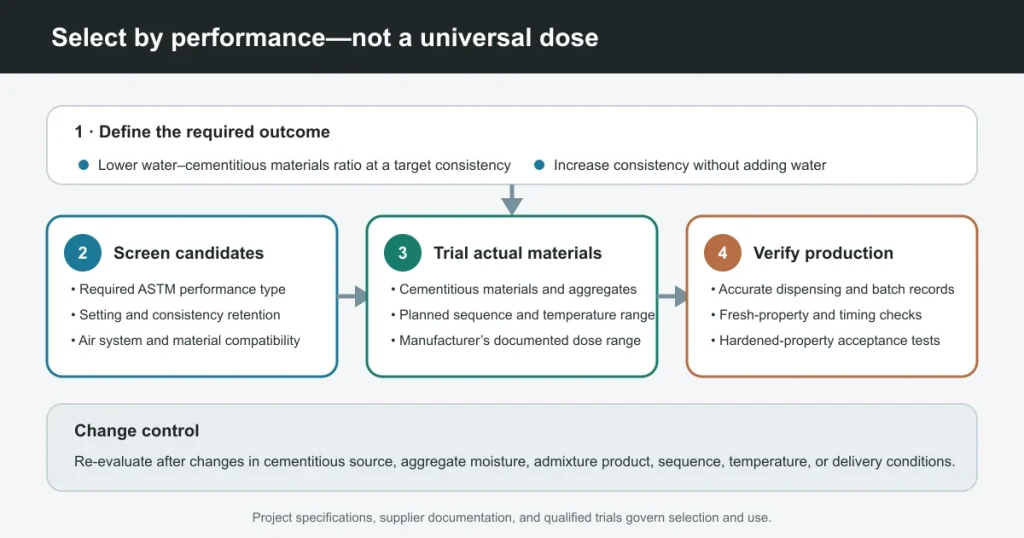
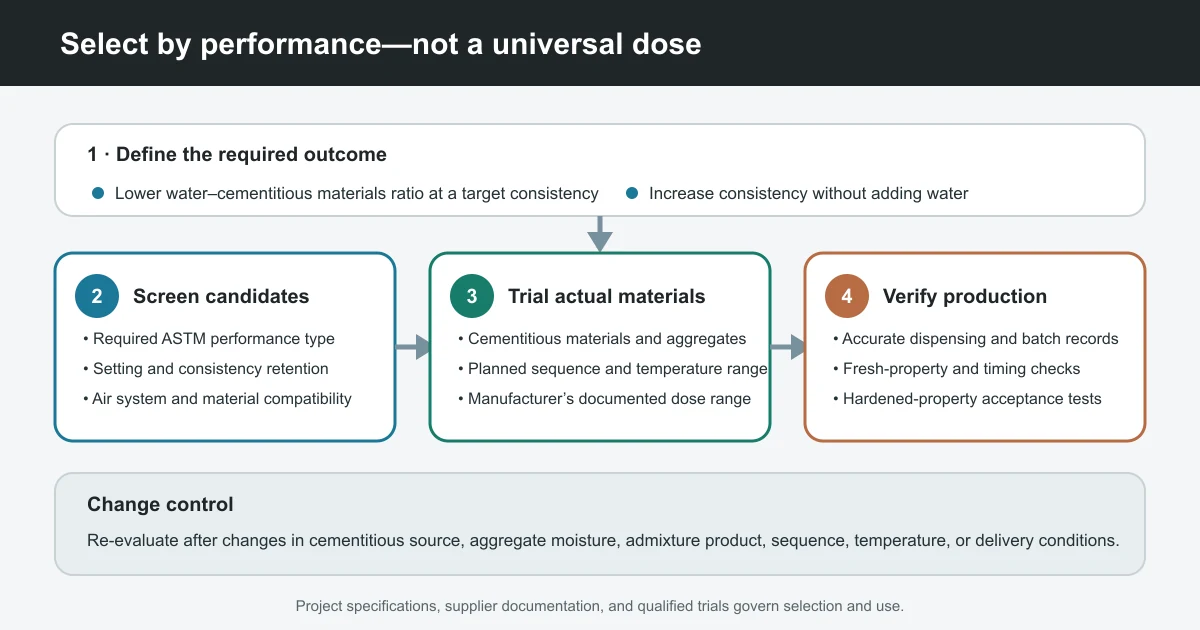
Start by defining the engineering objective
Product selection should begin with the decision the admixture must support, not with a preferred chemistry or a fixed dosage.
Define the objective in measurable terms:
- target water reduction at a defined consistency;
- required slump, slump flow, or other applicable fresh-concrete property at discharge and placement;
- expected transport and placement interval;
- setting and finishing window;
- pumping, consolidation, and stability needs;
- air-content requirements;
- strength ages and acceptance basis;
- relevant durability or transport-property requirements; and
- temperature and production ranges.
A project that needs lower w/cm at a similar slump is not the same as a project that needs higher slump at constant water. A mixture that must retain consistency for an extended delivery may need a different product or admixture system from one placed immediately after batching.
Selection and compatibility workflow
1. Establish the governing requirements
Identify the current project specification, applicable standard family, exposure requirements, permitted admixture Types, chloride restrictions, test methods, and approval responsibilities. Confirm whether the requirement is performance-based, prescriptive, or both.
2. Review the product documentation
Obtain current technical data, safety information, stated ASTM classification, recommended trial range, density or concentration information, storage requirements, shelf life, temperature limitations, and manufacturer instructions for dispensing and sequencing. Confirm the dosage basis: a percentage or mass rate is meaningless unless the reference mass and product condition are clear.
3. Screen the complete material system
Compatibility includes the actual hydraulic cement, SCMs, aggregates, mixing water, air-entraining admixture, set-controlling admixture, viscosity-modifying admixture, fibers, and any other relevant component. A product that works with one cementitious combination may respond differently after a source, lot, fineness, sulfate balance, SCM proportion, or temperature change.
4. Run controlled laboratory trials
Use representative materials and a trial matrix that includes a reference concrete and justified candidate dosages within the manufacturer’s recommended evaluation range. Keep moisture corrections, total water, batch size, mixing energy, addition sequence, and test timing traceable.
Measure more than initial slump. Depending on the project, the trial plan may include:
- slump, slump flow, or another applicable consistency measure at defined intervals;
- air content, concrete temperature, density, and yield;
- bleeding, segregation, finishability, pump response, and consolidation observations;
- time of setting;
- compressive strength at specified ages; and
- relevant length-change or durability-related tests.
5. Reproduce the operating window
Trials should cover the expected concrete-temperature range and the realistic time from batching through discharge and placement. An admixture response measured immediately in a small laboratory batch may not represent a production batch after transport, pumping, or delayed placement.
6. Confirm at production scale
Before routine use, conduct an authorized plant or field trial where required. Confirm dispenser accuracy, mixing uniformity, production sequence, retention, placement, finishing, and specimen procedures. Record deviations rather than treating them as normal variability.
7. Approve a controlled procedure
The approved procedure should identify the product, qualified dosage range, dosage basis, addition point, sequence, mixing requirement, permitted adjustments, test frequency, acceptance limits, responsible person, and change-control triggers.
Dosage and addition sequence are project-specific
There is no universal dosage percentage for water-reducing admixtures. A fixed range such as a percentage of cement mass can be misleading because products differ in concentration and active chemistry, and manufacturers may express dosage by mass or volume relative to cement or total cementitious materials.
Use the manufacturer’s current instructions as the starting boundary for evaluation, then establish the production dosage through trials with the actual materials. Do not assume that more admixture will provide proportionally more water reduction or longer retention. Excessive or poorly timed addition may cause unexpected setting, air, stability, retention, or finishing behavior.
Addition sequence also matters. The response can change depending on when the admixture contacts water and cementitious materials, the degree of initial wetting, the mixing duration, and the presence of other admixtures. Follow a documented sequence agreed with the concrete producer and admixture manufacturer and validated in trials.
If a jobsite addition is permitted, it should be measured, authorized, recorded, and followed by the approved mixing and retesting procedure. Record the cumulative dose. Uncontrolled redosing or simultaneous addition of incompatible products can invalidate the mixture basis and create safety, quality, and acceptance problems.
Production and quality-control checklist
- Confirm product identity, lot, storage condition, and shelf-life status.
- Verify dispenser calibration, units, zeroing, and delivery accuracy.
- Record the dosage and its basis for every affected batch.
- Keep aggregate moisture corrections and total mixing-water accounting current.
- Follow the approved order and timing of all water and admixture additions.
- Do not combine admixtures in a storage tank or dosing line unless the suppliers explicitly permit it.
- Record concrete and ambient temperature, batch time, arrival time, test time, and discharge time.
- Check initial and retained consistency at the specified intervals.
- Monitor air content, density or yield, bleeding, segregation, setting, pumping, placing, consolidation, and finishing as applicable.
- Make and cure specimens using the specified methods and compare results on a consistent basis.
- Trend results by material source, product lot, dosage, temperature, elapsed time, and production line.
- Trigger review when cementitious materials, admixtures, aggregates, water source, sequence, equipment, temperature range, or performance changes.
Common failure modes and incorrect assumptions
“A water reducer always increases strength”
Not necessarily. Strength may increase when water is actually reduced and a lower w/cm is achieved without adverse changes. But strength also depends on cementitious materials, air content, consolidation, curing, specimen preparation, temperature, and test age. If the admixture is used only to increase slump at the same water content, no lower w/cm has been created.
“Higher slump means more water”
An admixture can increase slump without added water, so slump alone does not reveal water content or w/cm. Conversely, an unauthorized water addition can also raise slump. Production records and total-water accounting are required to distinguish the two.
“The same product and dose will behave the same everywhere”
Changes in cement or SCM characteristics, aggregate moisture, temperature, mixing energy, sequence, or other admixtures can alter water demand, air, set, and retention. Requalification triggers should be defined before production begins.
“Water reduction automatically reduces drying shrinkage”
ACI’s technical FAQ on drying shrinkage cautions that water-reducing admixtures usually produce little reduction in drying shrinkage; some may increase early shrinkage, while later shrinkage may be similar to comparable concrete without the admixture. Shrinkage performance must be evaluated directly when it matters.
“ASTM compliance eliminates the need for project trials”
ASTM C494/C494M-24 classifies and qualifies admixture performance under defined testing conditions. It does not demonstrate compatibility with every project material combination or batching sequence. The standard’s supplementary-testing note is a direct reason to test the proposed system.
“Older flowing-concrete classifications are still current”
Some older technical publications cite ASTM C1017/C1017M for admixtures used to produce flowing concrete. ASTM lists C1017/C1017M-13e1 as withdrawn in 2022. It should not be presented as a current specification. Confirm the active project documents and use current standards rather than carrying historical designations into new work.
Frequently asked questions
What can a water-reducing admixture be used to achieve?
It may reduce mixing water at comparable consistency, increase consistency without increasing intended mixing water, or support an approved revised mixture proportion. These are distinct objectives and do not produce identical performance outcomes.
Does higher slump always mean that more water was added?
No. A water-reducing admixture can increase slump without added water, while unauthorized water can also raise slump. Slump alone cannot establish water content or the water-to-cementitious materials ratio.
Does a water-reducing admixture always increase concrete strength?
No. Strength may improve when mixing water is actually reduced and a lower water-to-cementitious materials ratio is achieved without adverse changes, but it also depends on air content, materials, consolidation, curing, temperature, specimen preparation, and test age.
Is there a universal dosage or addition sequence for water reducers?
No. Product concentration, dosage basis, cementitious materials, temperature, mixing energy, other admixtures, and elapsed time can change the response. Dosage and sequence must be established through documented trials and current manufacturer instructions.
Why are project trials needed if an admixture complies with ASTM C494/C494M?
ASTM classification does not demonstrate compatibility with every project material combination or production process. Trials should represent the actual materials, batching sequence, temperature and time window, equipment, placement conditions, and required fresh and hardened properties.
A performance decision, not a product shortcut
A water-reducing admixture is one part of a concrete mixture and production system. The correct selection is the product-and-procedure combination that meets the defined objective with the actual materials, within the expected temperature and time window, without creating unacceptable changes in air, setting, stability, strength development, finishability, durability-related properties, or production control.
The safest workflow is straightforward: define the objective, select the applicable performance category, test the complete material system, confirm the process at production scale, and control every change. That approach is more reliable than prescribing a universal chemistry, dosage, or sequence.
Authoritative references
- American Concrete Institute, What are water-reducing admixtures? — FAQ 722.
- American Concrete Institute, The effect of water-reducing admixtures on drying shrinkage — FAQ 731.
- American Concrete Institute, Committee 212 — Chemical Admixtures.
- ACI Committee 212, ACI PRC-212.3-16: Report on Chemical Admixtures for Concrete.
- ASTM International, ASTM C494/C494M-24: Standard Specification for Chemical Admixtures for Concrete.
- National Ready Mixed Concrete Association, CIP 15 — Chemical Admixtures for Concrete.
- ASTM International, Subcommittee C09.23 on Chemical Admixtures — current and withdrawn-standard status, including C1017/C1017M.