Technical Notice: This article provides general technical information, not a waterproofing design, product endorsement, or project specification. Required leakage performance, exposure, water pressure, crack control, joints, penetrations, membranes, coatings, admixtures, testing, and maintenance must be defined in the governing documents by qualified professionals. Product claims should be verified for the actual substrate, mixture, detailing, construction, and service conditions.
“Waterproof concrete” is often used as if it were a material grade. That wording can be misleading. Water control is a performance of the whole system: the concrete, cracks, joints, penetrations, embedded items, protective systems, drainage, workmanship, verification, and maintenance.
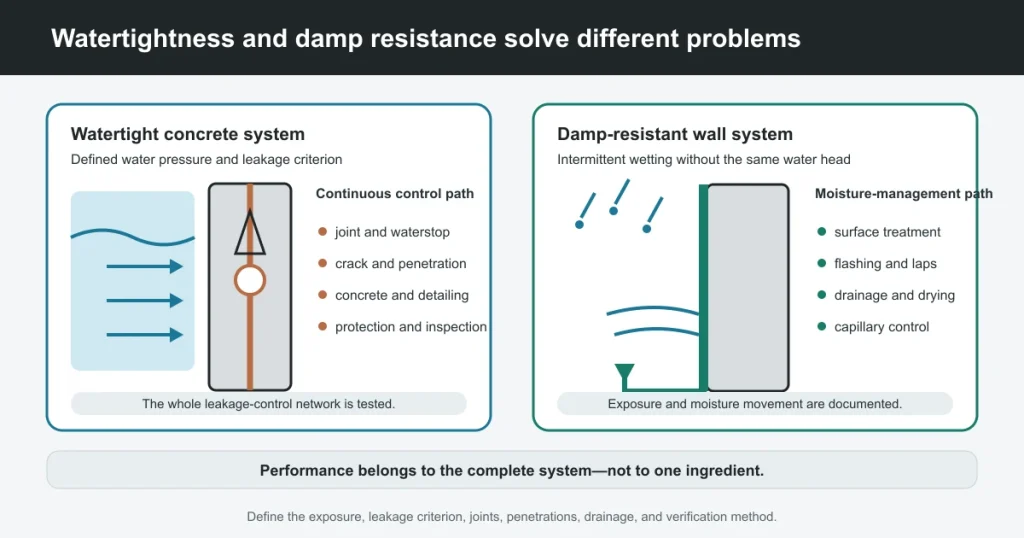
A useful distinction is between watertight performance, where the assembly must control leakage under a defined liquid head or pressure, and damp resistance, where the objective is to limit wetting or moisture movement without a sustained hydrostatic pressure requirement. The correct solution begins with the exposure and acceptance criterion—not with an admixture label.
Start by defining the water exposure
Water can interact with concrete in several ways:
- Capillary absorption: liquid is drawn into unsaturated pores from a wetted surface.
- Permeation: liquid flows through concrete under a pressure gradient.
- Vapour movement: water vapour migrates because of vapour-pressure differences.
- Diffusion: dissolved ions move in response to concentration gradients.
- Preferential flow: cracks, joints, tie holes, honeycombing, penetrations, and interfaces provide paths that may dominate the response.
These mechanisms are not interchangeable. ASTM C1585 measures the rate of water absorption by conditioned, unsaturated concrete with one surface exposed. It does not simulate every hydrostatic leakage condition. A result from one method should not be presented as universal proof that a structure is watertight.
What watertight performance means
A watertight system is designed and verified to control liquid leakage for a stated exposure and acceptance criterion. Typical applications include tanks, basins, reservoirs, below-grade enclosures, tunnels, pools, and process structures. The required performance can vary widely: a potable-water tank, an occupied basement, and a secondary-containment structure do not share the same leakage tolerance.
ACI CODE-350-20 addresses environmental engineering concrete structures, while ACI SPEC-350.1-22 provides tightness-test procedures for applicable containment structures. Those documents illustrate an important principle: watertightness must be connected to a defined structure, test method, test stage, liquid level or pressure, observation period, corrections, and acceptance rules.
Low transport through intact concrete is necessary in many systems, but it is not sufficient. A narrow through-crack or unsealed penetration can pass more water than the surrounding concrete matrix. Joint layout, waterstops, sealants, penetrations, crack control, restraint, curing, and inspection therefore require the same attention as mixture proportions.
What damp resistance means
Damp resistance is generally aimed at limiting wetting, capillary uptake, staining, efflorescence, or moisture transfer where sustained hydrostatic pressure is not the governing condition. Examples can include façades exposed to rain, splash zones, above-grade walls, plinths, and surfaces where moisture-sensitive finishes require protection.
The term still needs a measurable definition. Is the target lower absorption, reduced visible wetting, limited vapour transmission, prevention of rain penetration, or protection of an interior finish? Each objective may require a different test and assembly.
Surface treatments may reduce absorption or repel liquid water while remaining vapour-permeable, but their effectiveness depends on substrate moisture, preparation, crack width, application rate, ultraviolet exposure, abrasion, chemistry, and maintenance. A treatment that performs under intermittent rain should not be assumed to resist hydrostatic pressure.
A comparison based on performance
| Decision | Watertight system | Damp-resistant system |
|---|---|---|
| Typical exposure | Sustained or intermittent liquid head; leakage has defined consequences | Wetting, rain, splash, or capillary moisture without a sustained pressure requirement |
| Primary acceptance | Leakage or tightness criterion under a specified test or service condition | Absorption, wetting, vapour, coating, or finish criterion under a specified method |
| Critical details | Cracks, movement and construction joints, waterstops, penetrations, liners, continuity | Surface preparation, cracks, interfaces, treatment continuity, drainage, vapour path |
| Verification | Whole-structure or system test plus construction records and inspection | Material or assembly tests, mock-ups, wetting observations, adhesion and coverage checks |
| Maintenance | Joints, sealants, liners, penetrations, drainage and repaired cracks | Surface treatment, façade joints, drainage, coatings and finish interfaces |
The same concrete can be part of either system, but the design basis and verification are different.
Building a watertight concrete system
1. Define function and consequence
Record the contained or excluded liquid, chemical composition, pressure range, temperature, wet-dry cycles, acceptable leakage, occupied spaces, contamination risk, and access for repair. The governing code and contract may impose additional requirements.
2. Design for crack and movement control
Crack width is affected by reinforcement, restraint, member geometry, thermal and drying movements, construction sequence, curing, and service loads. No mixture can compensate for missing movement joints or inadequate reinforcement detailing. Joints should be located, detailed, and sequenced deliberately; penetrations and embedded items need compatible water-control details.
3. Develop low-transport, constructible concrete
Control w/cm, total water, paste volume, segregation, bleeding, and compatibility while maintaining enough workability for placement and consolidation. Supplementary cementitious materials and chemical admixtures can improve selected transport properties, but their effects depend on source, proportion, curing, temperature, age, and test method.
NRMCA TIP 24 describes permeation, absorption, and diffusion as distinct transport processes and emphasizes the influence of mixture proportions and execution. A dense laboratory specimen does not represent concrete containing honeycombing, cold joints, or poorly cured cover.
4. Execute and document
Verify batching, aggregate moisture corrections, authorized water or admixture adjustments, placement rate, lift interfaces, consolidation, form ties, joint preparation, waterstop position, curing, protection, and repair of defects. Inspection should occur before details are concealed.
5. Test the correct system
Use a test specified for the actual performance question. Material-level absorption or electrical tests may support mixture qualification, but a containment structure may also require a defined tightness test. Establish when the test occurs, how temperature and evaporation are accounted for, what constitutes leakage, and who decides on repairs and retesting.
Admixtures: useful tools, not universal guarantees
Permeability-reducing admixtures may reduce water penetration by modifying the pore structure, blocking or narrowing capillary pathways, or introducing hydrophobic behavior. The classification and intended exposure should be verified against the current product data, relevant standard, and independent tests.
Important checks include:
- compatibility with cementitious materials and other admixtures;
- effects on setting, air, workability retention, bleeding, strength, and shrinkage;
- curing and temperature sensitivity;
- performance under the relevant pressure or absorption method;
- influence of cracks and joints;
- dosage, sequencing, mixing energy, and field control; and
- chemical exposure and long-term maintenance.
Silica fume is a supplementary cementitious material, not automatically a “waterproofing admixture.” It can reduce transport in a well-proportioned, well-cured mixture, but it can also change water demand, workability, bleeding, finishing, and early drying risk. Polymer products, crystalline products, hydrophobic agents, and surface treatments likewise require mechanism-specific evidence.
Testing without overclaiming
ASTM’s C09.66 subcommittee lists active methods for absorption, voids, chloride transport indicators, diffusion, and electrical resistivity. These tests answer different questions. Results are affected by conditioning, age, moisture, specimen location, curing, and surface treatment.
For example:
- ASTM C1585 evaluates capillary absorption of conditioned concrete exposed on one face.
- ASTM C642 evaluates density, absorption, and voids after specified conditioning.
- ACI SPEC-350.1-22 addresses tightness testing of applicable environmental containment structures.
Do not convert a laboratory result into an unsupported claim such as “zero permeability” or “permanently waterproof.” State the method, age, conditioning, units, acceptance threshold, and limitations.
Diagnosing leakage or dampness
Begin with the path, not the patch. Map the moisture location, timing, weather, water level, pressure, joints, cracks, penetrations, drainage, and previous repairs. Distinguish liquid leakage from condensation, vapour, plumbing, and construction moisture.
The visible exit point may be far from the entry point. Tracing, controlled ponding, moisture surveys, crack mapping, cores, or other tests may be appropriate when selected by a qualified investigator. Repairs should address the source, pathway, movement, and consequence. Sealing the interior face without controlling external water or pressure can relocate the leakage.
Frequently asked questions
Is low-permeability concrete automatically watertight?
No. Low transport through intact concrete helps, but cracks, joints, tie holes, penetrations, honeycombing, and interfaces often govern leakage. Watertightness is a system performance.
Can a surface sealer make a tank watertight?
Only if the complete product and substrate system is designed, prepared, applied, and verified for the stated liquid, pressure, movement, and service conditions. A treatment intended for rain or capillary absorption is not automatically suitable for containment.
Which single test proves waterproof concrete?
There is no universal single test. Select tests for the actual mechanism and acceptance criterion, and distinguish material tests from whole-structure tightness testing.
Related reading
- Concrete Durability: Exposure, Transport, Materials, and Execution
- The Interfacial Transition Zone in Concrete
- Explore technical consulting
Technical references
- American Concrete Institute, ACI CODE-350-20—Code Requirements for Environmental Engineering Concrete Structures and Commentary: https://www.concrete.org/store/productdetail.aspx?ItemID=350U20&Language=English&Units=US_Units
- American Concrete Institute, ACI SPEC-350.1-22—Tightness Testing of Environmental Engineering Concrete Structures: https://www.concrete.org/Portals/0/Files/PDF/Previews/350.1-22_preview.pdf
- ASTM International, ASTM C1585-20—Rate of Absorption of Water by Hydraulic-Cement Concretes: https://store.astm.org/standards/c1585
- ASTM International, Subcommittee C09.66—Concrete’s Resistance to Fluid Penetration: https://www.astm.org/membership-participation/technical-committees/committee-c09/subcommittee-c09/jurisdiction-c0966
- National Ready Mixed Concrete Association, TIP 24—Permeability of Concrete: https://www.nrmca.org/wp-content/uploads/2022/11/TIP24w.pdf
- American Concrete Institute, Factors affecting permeability: https://www.concrete.org/frequentlyaskedquestions.aspx?faqid=660