
Technical Notice
This article explains a materials-science concept; it is not a concrete mixture design, durability specification, or acceptance procedure. The microstructure and practical significance of an interfacial transition zone depend on the actual cementitious system, aggregate, moisture condition, production history, curing, exposure, specimen preparation, and measurement method. Project decisions should be based on current contract documents, representative testing, and qualified technical review.
Concrete is not simply hardened cement paste filled with inert particles. It is a multiscale composite in which paste, aggregate, pores, air voids, cracks, and their interfaces interact. One of those interfaces is the interfacial transition zone, usually abbreviated ITZ: the region of cement paste immediately influenced by the presence of an aggregate surface.
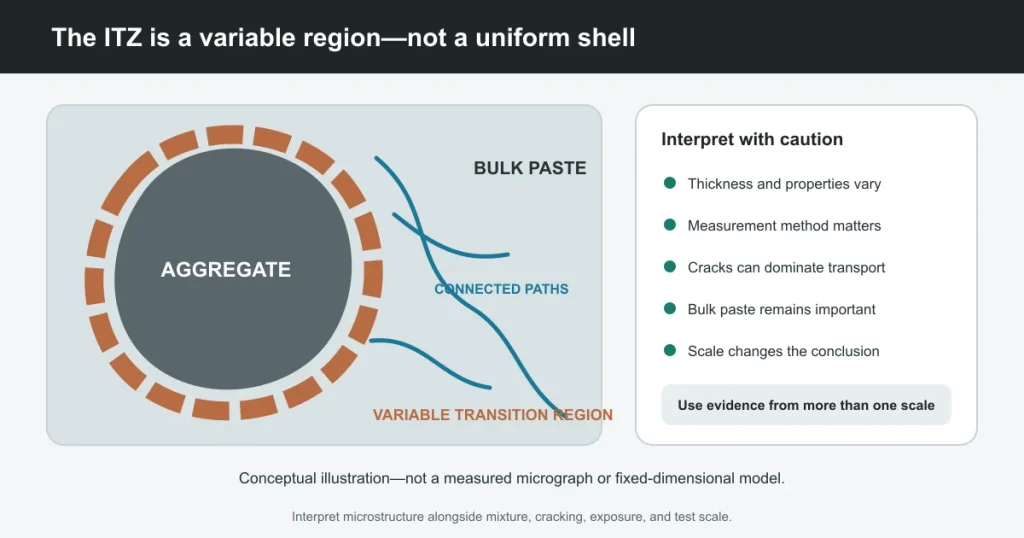
The ITZ is small relative to a concrete member, but it can matter because every aggregate particle introduces an interface. At the same time, calling it the weak layer is too simple. The ITZ is not a coating with one composition, one thickness, or one property. It is a spatially variable microstructural concept whose relevance changes with the material system and the property being studied.
The ITZ is a region, not a uniform shell
At a polished cross section, researchers may detect changes in porosity, unhydrated cement content, hydration products, or another measured property as distance from an aggregate surface increases. That changing region is commonly described as the ITZ.
The boundary is operational rather than perfectly sharp. Where the ITZ “ends” depends on what is measured, the spatial resolution of the instrument, the statistical method, and the criterion used to distinguish near-interface paste from bulk paste. An elastic-property model, an image-analysis study, and a moisture-transport experiment may therefore describe the same material using different effective ITZ dimensions.
NIST analytical work explicitly treats the real ITZ as a gradient of porosity and properties, even when a simplified model uses spherical aggregate and a defined zone width for calculation.[2] That distinction is essential: the model boundary is a useful abstraction, not proof that a continuous, uniform layer surrounds every real aggregate.
Why paste near aggregate can develop differently
Particle packing and the wall effect
Cement and other fine particles cannot pack against a much larger aggregate surface exactly as they pack within unrestricted bulk paste. The aggregate acts as a boundary, changing the local arrangement of particles. NIST’s concrete microstructure program describes this wall effect as one of the concepts used to explain interfacial-zone formation.[1]
The effect is statistical. It does not mean that every point at every aggregate surface has the same local water content or pore structure. Fresh-concrete stability, particle-size distribution, aggregate geometry, orientation, and local movement can all influence the microstructure that develops.
Hydration occurs within a nonuniform starting structure
As cementitious materials hydrate, solids form and the pore system evolves. Because the initial particle arrangement near an aggregate can differ from that of bulk paste, the later distribution of hydration products and capillary space may also differ. Continued hydration may reduce contrasts in some systems, while local heterogeneity can remain in others.
Supplementary cementitious materials can alter particle packing, reactions, and pore development. NIST has modeled and experimentally examined interfacial zones both with and without mineral additions.[1] However, this evidence does not justify a universal claim that one material will always “eliminate” the ITZ or produce the same benefit with every cement, aggregate, dosage, curing history, and age.
Aggregate is an active part of the interface
Aggregate characteristics extend beyond nominal size. Mineralogy, stiffness, coefficient of thermal expansion, shape, texture, surface condition, porosity, and absorption can affect the surrounding composite. A NIST/Federal Highway Administration study found that concrete performance varied among aggregate sources and that most simple correlations between a single aggregate characteristic and overall performance were weak.[5]
That finding supports a systems view. Surface roughness, for example, may change local mechanical interlock and paste arrangement, but it is not an isolated control knob. In a primary study using a single spherical model aggregate, backscattered-electron microscopy showed that the porosity gradient varied around the particle; rough and smooth surface regions differed, and orientation relative to gravity also mattered.[3] The result demonstrates local variability, not a rule that every rough natural aggregate will create the same ITZ.
Porous lightweight aggregate provides another useful caution. NIST research reports that aggregate porosity and absorption can substantially change ITZ microstructure, and that some lightweight-aggregate mortar systems developed a near-interface region unlike the one commonly associated with normal-weight aggregate.[7] Results from a specific internal-curing system should not be transferred directly to unrelated concrete.
Spatial variability changes how the ITZ should be interpreted
A real concrete contains many aggregate particles with irregular shapes, different orientations, and varying distances between them. Near-interface regions may be isolated, may overlap locally, or may form connected paths in a microstructural model. This concept is called percolation.
Connectivity is different from local porosity. A locally more porous region does not automatically create a continuous route through a specimen. Whether ITZ regions connect depends on the aggregate system, zone definition, paste structure, and geometry being modeled. Cracks, bulk-paste pores, and air voids can also dominate a transport path.
This is why a single micrograph cannot establish the behavior of an entire concrete member. It samples one plane, one location, and one preparation history. A representative interpretation requires enough observations, suitable statistics, and a method matched to the engineering question.
How researchers characterize an ITZ—and where uncertainty enters
Backscattered-electron microscopy
Backscattered-electron scanning electron microscopy can distinguish phases and pores in a carefully prepared polished section. Image analysis may then estimate how a selected feature changes with distance from an aggregate surface. This method has helped researchers quantify gradients and compare models with physical specimens.[1][3]
Its limitations matter. Specimen drying, impregnation, cutting, and polishing can alter or obscure delicate features. Threshold selection and segmentation affect the reported phase fractions. A two-dimensional section also intersects a three-dimensional interface at an unknown orientation.
X-ray and neutron imaging
X-ray and neutron techniques provide complementary information because they respond differently to dense solids and hydrogen-rich materials such as water. Time-resolved imaging can examine moisture movement without relying only on a polished surface.
In a 2022 study of unsaturated water ingress around a single coarse aggregate, researchers using combined neutron and X-ray tomography did not detect preferential water movement around the aggregate at the resolution and under the conditions of the experiment.[4] This is important counterevidence to the broad claim that the ITZ must always act as a fast moisture channel. It is also not proof that no ITZ can influence any transport process in any mixture.
Electrical measurements and computational models
Electrical conductivity can be sensitive to pore solution and connectivity, but it does not map one-to-one onto field permeability or durability. In one NIST-associated mortar study, local conductivity differed between ITZ and matrix paste, yet the ITZ did not significantly change the measured global electrical conductivity of the mortar.[6]
Computational models are valuable for testing how geometry, zone properties, aggregate volume, and connectivity could affect composite behavior.[2][8] Their output remains conditional on assumptions such as aggregate shape, assigned zone properties, and phase connectivity. A model should be validated against observations before it is used to support a project decision.
Mechanical implications: important, but not exclusive
The aggregate-paste interface participates in stress transfer. Differences in stiffness, shrinkage, thermal movement, local porosity, bond, and existing defects can concentrate stress or influence a fracture path. For that reason, the ITZ is often discussed in explanations of tensile behavior, elastic response, and cracking.
But the ITZ does not act alone. Concrete response also depends on:
- bulk-paste strength and pore structure;
- aggregate stiffness, strength, shape, texture, and thermal properties;
- air-void content and distribution;
- curing and moisture history;
- existing cracks and damage;
- specimen geometry, loading rate, and test method.
A crack may follow an interface in one region, cross paste in another, and pass through a weaker aggregate elsewhere. Describing the ITZ as always the weakest link hides that competition. It is more accurate to ask whether the local interface is likely to influence the specific failure mode in the material being evaluated.
Transport and durability: connectivity is the key question
Durability-related transport can involve liquid water, water vapor, dissolved ions, or gases. Each follows different driving forces and interacts with saturation, cracking, pore size, binding, and chemical reactions. A local ITZ contrast therefore does not translate automatically into a global durability result.
The practical questions are:
- Does the near-interface region differ meaningfully from bulk paste for the transport process of interest?
- Are those regions sufficiently connected to affect specimen-scale movement?
- Are cracks or the bulk-paste pore network more influential?
- Does the laboratory conditioning represent the exposure being evaluated?
The research record contains results that depend on system and method. NIST work on conductivity found local differences without a significant global effect in the tested mortars.[6] The neutron/X-ray study found no preferential unsaturated water ingress around its single aggregate.[4] A separate lightweight-aggregate mortar study linked a changed ITZ network with reduced chloride ingress in that particular system.[7] Together, these findings support a conditional conclusion: ITZ effects on transport are possible, but they must be demonstrated rather than assumed.
Design and quality-control takeaways
ITZ knowledge is most useful as a framework for asking better questions, not as a standalone mixture prescription.
Define the performance question first
Clarify whether the concern is early-age cracking, tensile fracture, modulus, moisture transport, ionic ingress, thermal compatibility, or another property. A characterization method suitable for one question may not answer another.
Qualify the complete material system
Evaluate the proposed cementitious materials, aggregate sources, admixtures, water, proportions, moisture corrections, production sequence, and curing together. A generic statement about “dense ITZ” cannot replace representative trial batches and performance testing.
Preserve material and process records
When an interface-related problem is suspected, retain records for aggregate source and condition, gradation, moisture and absorption, mixture proportions, batching changes, fresh-concrete stability, consolidation, curing, temperature history, and specimen preparation. Without that context, a micrograph is difficult to interpret.
Match evidence to scale
Microscopy can explain local structure; it does not by itself establish member-scale durability. Bulk tests can identify a performance difference; they may not identify the responsible microstructural mechanism. Strong investigations connect observations across scales without claiming more than each method can show.
Common ITZ myths
“The ITZ is one continuous layer with a fixed thickness”
It is better understood as a measured gradient whose apparent extent depends on material and method.
“The ITZ is always the weakest part of concrete”
It can influence bond and fracture, but the controlling path depends on paste, aggregate, defects, loading, and environmental history.
“More aggregate surface automatically means higher permeability”
Surface area alone does not establish connectivity or the governing transport path.
“One microscope image proves a durability mechanism”
A single image is local evidence. Representative sampling, statistics, complementary tests, and exposure context are needed.
“One additive removes the ITZ problem”
Materials may modify near-interface microstructure, but performance must be verified with the complete system and the relevant property.
ITZ review checklist
Before accepting an ITZ-based explanation or recommendation, ask:
- Is the ITZ defined by a measured property rather than a presumed fixed layer?
- Are aggregate type, surface condition, absorption, and geometry documented?
- Are paste composition, age, curing, and moisture state reported?
- Could specimen preparation have created or hidden features?
- Is the observation two-dimensional or three-dimensional?
- Has local evidence been connected to a bulk performance test?
- Is connectivity demonstrated, or merely assumed from local porosity?
- Are cracks, air voids, and bulk-paste transport considered?
- Are model assumptions and imaging resolution stated?
- Is the conclusion limited to the tested materials and conditions?
Frequently asked questions
What is the interfacial transition zone in concrete?
The interfacial transition zone, or ITZ, is the region of cement paste whose microstructure is influenced by a nearby aggregate surface. It is better understood as a spatially variable gradient than as a uniform coating.
Does the ITZ have one fixed thickness?
No. Its apparent extent depends on the material system, property being measured, instrument resolution, statistical method, and criterion used to distinguish near-interface paste from bulk paste.
Is the ITZ always the weakest part of concrete?
No. It can influence bond, stress transfer, and fracture, but the controlling path also depends on bulk paste, aggregate properties, air voids, defects, curing, moisture history, loading, and the test method.
Does water always move faster through the ITZ?
No. Local microstructural differences do not automatically create a connected transport path. Evidence from one material system and test condition should not be generalized to every concrete system.
Can one microscope image prove an ITZ-related durability mechanism?
No. A micrograph represents one plane, location, and specimen-preparation history. A defensible interpretation requires representative sampling, suitable statistics, complementary measurements, and evidence that connects local observations to bulk performance.
A small region with a system-level lesson
The interfacial transition zone matters because concrete performance emerges from interactions, not isolated ingredients. Near an aggregate surface, particle packing, hydration, aggregate characteristics, and local geometry can create a microstructure that differs from bulk paste. That region may affect stress transfer, fracture, or transport—but its influence is spatially variable and property-specific.
The sound engineering position is neither to ignore the ITZ nor to make it responsible for every concrete problem. Define the question, characterize the actual material at an appropriate scale, test the relevant performance, and keep conclusions within the limits of the evidence.
Authoritative references
- National Institute of Standards and Technology, Concrete and Mortar Microstructure.
- Garboczi, E. J., and Bentz, D. P., Analytical Formulas for Interfacial Transition Zone Properties, NIST publication record.
- Garboczi, E., Lyu, K., She, W., and Miao, C., The Effect of Rough vs. Smooth Aggregate Surfaces on the Characteristics of the Interfacial Transition Zone Around a Single Spherical Aggregate, NIST publication record.
- Dalton, L. E., LaManna, J., Jones, S., and Pour-Ghaz, M., Does ITZ Influence Moisture Transport in Concrete?, NIST publication record.
- Bentz, D. P., et al., Influence of Aggregate Characteristics on Concrete Performance, NIST Technical Note 1963.
- Shane, J. D., et al., Effect of the Interfacial Transition Zone on the Conductivity of Portland Cement Mortars, NIST publication record.
- Bentz, D. P., Influence of Internal Curing Using Lightweight Aggregates on Interfacial Transition Zone Percolation and Chloride Ingress in Mortars, NIST publication record.
- Bentz, D. P., and Garboczi, E. J., Computer Modelling of Interfacial Transition Zone: Microstructure and Properties, NIST publication record.