
Technical Notice: This article provides general technical information, not a project specification, condition assessment, or service-life guarantee. Exposure classification, design service-life objectives, concrete cover, water-to-cementitious materials ratio, strength, air requirements, material limits, test methods, and acceptance criteria must come from the governing documents and qualified project professionals. Use current locally applicable codes and standards. Verify all project decisions with the actual materials, member geometry, construction process, and exposure.
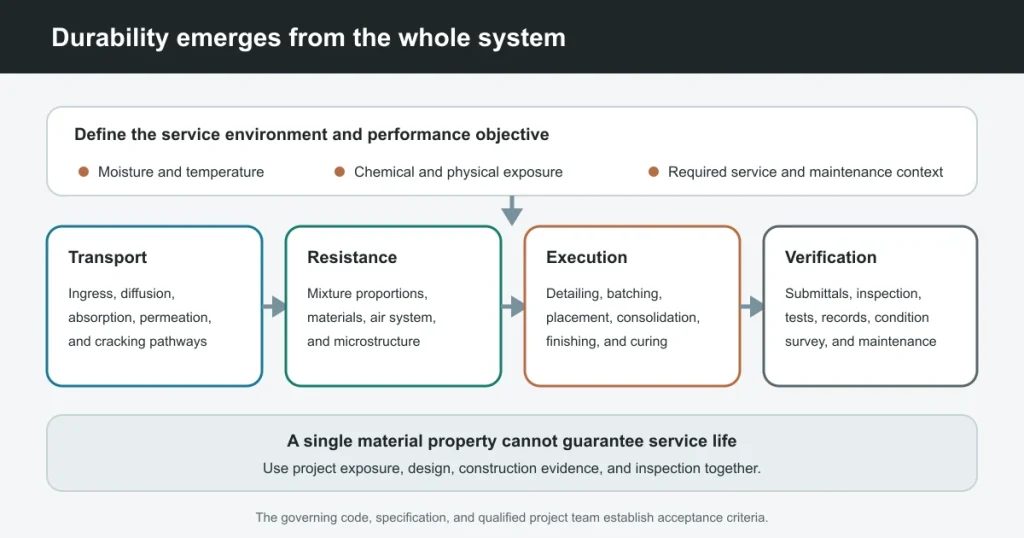
Concrete durability is the ability of a concrete system to retain its required function in the intended service conditions. It is not one material property and cannot be established by compressive strength alone. Durable performance depends on exposure, transport, compatible materials, detailing, execution, verification, and maintenance.
ACI PRC-201.2-23 organizes durability around mass transport and distinct deterioration mechanisms, including freezing and thawing, alkali-aggregate reaction, sulfate and aggressive chemical attack, physical salt attack, corrosion, and abrasion.[1] That organization supports a useful rule: do not treat every symptom as the same problem, and do not expect one mixture adjustment to control every exposure.
A practical durability model
A clear durability review can follow this chain:
Exposure → transport or physical action → reaction or initiation → damage → changed transport
The chain is a decision aid, not a universal law. Abrasion, for example, is a direct physical action, while reinforcement corrosion typically requires an initiating condition and a supporting environment. Once cracking or surface loss occurs, transport pathways can change, allowing water, gases, or dissolved ions to move differently. NIST research notes that transport properties should not automatically be assumed constant as degradation progresses.[3]
The framework prompts a project team to identify the exposure at each member, the relevant pathway or action, the resulting mechanism and damage, and the controls that can interrupt that sequence.
Start with exposure, not a favorite solution
Exposure is member-specific. Different faces of the same structure can experience different wetting, temperature, chemical, and mechanical conditions. Consider normal service, seasonal variation, credible abnormal events, and changes caused by drainage, operations, or maintenance.
Exposure families include:
- repeated wetting and drying;
- freezing and thawing when sufficient moisture is present;
- external chlorides, including deicing salts, spray, or saline water;
- water-soluble sulfates in contacting soil or water;
- acids or other aggressive industrial chemicals;
- carbonation in the cover concrete;
- abrasion, erosion, or cavitation;
- heat, fire, or thermal gradients;
- conditions that can support alkali-aggregate reaction; and
- salt crystallization under suitable moisture and environmental cycles.
Marine service illustrates why labels are not enough. A member may face chlorides, moisture gradients, wet-dry cycling, sulfate-bearing water, waves, abrasion, and cracking at the same time. Submerged, splash, tidal, and atmospheric zones may have different controlling mechanisms. “Marine concrete” is therefore an exposure description, not a complete mixture specification.
The governing framework may assign formal exposure categories and classes. NRMCA CIP 44 emphasizes identifying service and environmental conditions during design, addressing them in specifications, and assigning exposure by member type.[5] Requirements should follow the classifications that actually apply.
Understand the transport pathways
Many durability processes depend on movement through concrete. The relevant mode depends on moisture, pressure, concentration gradients, temperature, pore structure, and defects.
Capillary absorption draws liquid into unsaturated pores. Sorptivity can characterize this behavior under a defined conditioning and test procedure, but it is not a universal service-life number.
Permeation is pressure-driven bulk flow. It may matter for liquid-retaining, hydraulic, buried, or pressurized members.
Diffusion moves dissolved species in response to concentration gradients. Binding, saturation, temperature, aging, materials, and test method affect apparent parameters, so results from different methods are not automatically interchangeable.
Gas movement matters for carbonation and moisture exchange. Surface treatments, internal moisture, cracks, and environmental cycling can change the rate.
Cracks, joints, interfaces, tie holes, honeycombing, and poorly consolidated zones can act as preferential pathways. A low-transport laboratory specimen does not compensate for discontinuities in the constructed member.
Transport is central, but it is not the whole durability problem. The transported agent must be connected to a relevant mechanism, and direct physical actions such as abrasion must be evaluated on their own terms.
Match materials and mixture proportions to the mechanisms
A durability-oriented mixture is a coordinated system, not a checklist of isolated ingredients.
Cementitious system
The cementitious system influences hydration, pore structure, transport, heat development, chemical resistance, and admixture compatibility. Supplementary cementitious materials can improve selected durability properties in an appropriately proportioned and cured mixture, but effects depend on the materials, proportions, temperature, age, and exposure. A benefit for one mechanism should not be assumed for all others.
Water-to-cementitious materials ratio
Controlling the water-to-cementitious materials ratio can reduce transport potential when concrete is properly consolidated and cured. No value applies universally. The project limit must be compatible with placement, finishing, curing, and acceptance, while uncontrolled water additions can defeat the intended mixture.
Aggregates
Aggregates influence dimensional stability, abrasion resistance, thermal response, and alkali-aggregate reaction. Selection should use relevant source history and testing. Alkali-silica reaction is one form of alkali-aggregate reaction; the terms are not universally interchangeable. Map cracking alone is not proof because several mechanisms can produce similar symptoms.
Air-void system
Where wet freezing-and-thawing exposure governs, the required air-void system must follow the project framework and suitable verification. Fresh-concrete air content does not fully describe the hardened air-void structure, and a generic value should not be transferred between exposure classes.
Admixtures and consistency
Admixtures may support a durability strategy, but their effects are mixture- and condition-dependent. Trials should represent the proposed materials, sequence, temperature, mixing, and placement. An admixture does not replace controls for detailing, segregation, curing, or cracking.
Detailing and construction determine what is actually built
Mixture potential becomes field performance only through design and execution.
Durability detailing should manage water. Review slopes, drainage, drips, joints, penetrations, interfaces, and access for maintenance. Cover, reinforcement layout, member thickness, crack control, joints, and movement accommodation must follow the governing design. Congestion or inaccessible geometry can still make consolidation and cover control difficult.
Construction controls should address:
- batching accuracy and authorized adjustments;
- mixture temperature, transport time, and consistency retention;
- stable placement without segregation;
- consolidation around reinforcement, corners, and embedded items;
- finishing without trapping bleed water or damaging the surface;
- prompt, continuous curing suited to the mixture and weather;
- protection from early drying, freezing, temperature change, and impact; and
- documented treatment of joints, penetrations, repairs, and surface systems.
Poor curing can leave the cover zone more permeable even when strength specimens pass. Honeycombing, unsealed joints, scaling, or early cracking can create pathways not represented by laboratory mixture qualification.
Mechanism-specific cautions
Reinforcement corrosion: Carbonation can reduce the alkalinity protecting embedded steel, while chlorides can provide a different initiation pathway. Surface chloride or rust staining alone does not establish the full condition. Cover, chloride profile, carbonation depth, moisture, cracking, and steel condition may all matter.
Sulfate and chemical attack: External sulfate attack, salt crystallization, acid attack, leaching, and seawater exposure are not one mechanism. Distinguish paste chemistry from physical crystallization, transport damage, and reinforcement corrosion. Select materials for the identified exposure, not the word “chemical.”
Freezing and thawing: Risk depends on moisture and saturation as well as freezing conditions, pore structure, air-void system, aggregates, surface treatment, and deicing exposure. Cold weather alone does not define damage potential.
Alkali-aggregate reaction: Reactive aggregate, available alkalis, and moisture are central considerations, but field diagnosis requires more than crack patterns. Petrography, expansion evidence, records, and exposure history may be needed.
Abrasion, erosion, and cavitation: These are distinct physical processes. Traffic, suspended solids, flow, impact, turbulence, finishing, aggregates, and geometry can affect the outcome. Higher strength alone does not guarantee resistance to every wear condition.
A decision framework for design and delivery
Use the following sequence to build a defensible durability plan:
- Define function and service-life intent. Identify performance objectives, acceptable deterioration states, access constraints, and maintenance assumptions.
- Classify exposure by member and zone. Record moisture, temperature, chemicals, mechanical actions, severity, duration, and variability.
- Map pathways and mechanisms. Connect each exposure to likely transport routes or direct actions, initiation processes, and potential damage.
- Select coordinated controls. Combine drainage, cover and crack control, materials, protective systems, execution, and maintenance.
- Make requirements verifiable. State submittals, trials, sampling, test methods, acceptance rules, records, and responsibilities.
- Confirm the as-built condition. Review records, curing, cover, defects, joints, repairs, and test results.
- Monitor and maintain. Establish inspection triggers, drainage and joint care, surface-system renewal, and a process for investigating change.
| Exposure or action | Likely pathway or action | Potential consequence | Evidence to consider |
|---|---|---|---|
| External chlorides | Absorption, diffusion, cracks, or joints | Corrosion initiation and later cracking or spalling | Exposure history, cover, chloride profile, moisture, cracking, electrochemical and direct observations |
| Carbonation | Gas movement through cover concrete | Loss of steel passivity where the front reaches reinforcement | Carbonation depth, cover, moisture history, cracking, steel condition |
| Sulfate-bearing soil or water | Moisture and ion transport | Expansion, softening, cracking, or material loss depending on mechanism | Exposure chemistry, cementitious system, microstructure, petrography, dimensional or strength change |
| Freezing with moisture | Pore saturation followed by phase change | Scaling, internal cracking, or aggregate-related distress | Climate and wetness history, air-void evidence, absorption, materials records, distress depth |
| Abrasive or erosive service | Contact, impact, or fluid-borne particles | Surface loss, roughness, section reduction | Load and flow history, particle characteristics, geometry, surface condition, material properties |
| Potential alkali-aggregate reaction | Internal reaction under enabling conditions | Expansion and cracking | Aggregate and mixture records, moisture, petrography, expansion indicators, crack mapping |
Diagnostic cautions for existing concrete
A photograph or crack map can guide an investigation, but rarely proves the mechanism. Several deterioration processes can coexist, and the original cause may be obscured after repairs or years of exposure. Damage can also alter transport, so a parameter measured today may not represent the undamaged material.
Begin with records, exposure history, drainage and operating changes, repair history, and a systematic condition survey. Then choose tests that can discriminate between plausible mechanisms. Record sample location, depth, orientation, conditioning, units, method, age, and uncertainty. Chloride profiles, carbonation testing, cover measurement, crack surveys, electrochemical methods, cores, microscopy, and petrography may be useful when selected for a defined question. Do not combine results from different methods as if they measure the same property.
Repair design should control the source and pathway as well as the visible damage. Patching delaminated concrete without addressing continuing moisture, chlorides, movement, drainage, or incompatible materials can relocate or accelerate distress.
Verification and maintenance
Verification should follow approved inputs through the finished member. Evidence may include material records, trials, fresh-concrete tests, strength results, curing logs, weather, cover surveys, visual acceptance, transport tests, and checks of joints or protective systems. The useful set depends on the exposure and contract; no single test proves durability.
Maintenance is part of the durability system. Keep drains and joints functional, repair leaks, renew protective systems, track changes, and investigate unexpected trends. Inspection and intervention should reflect consequence, access, environment, and observed performance.
Service-life intent is not a guarantee
A design service-life objective guides material, detailing, execution, inspection, and maintenance decisions. A service-life prediction is a conditional model result based on a stated mechanism, material parameters, exposure history, boundary conditions, workmanship assumptions, maintenance, and a chosen limit state. NIST’s sorptivity-based research similarly describes the need to identify the degradation mechanism, measure relevant material properties, and characterize the exposure before modeling service life.[4]
Exposures and constructed properties vary, and mechanisms may interact or change transport. Present predictions with assumptions, uncertainty, sensitivity, validation evidence, and an update plan—not as a warranty tied to a date.
Concrete durability checklist
Before design and specification
- Define required function, service-life intent, limit states, and maintenance assumptions.
- Classify exposure for every relevant member and zone.
- Identify transport pathways, direct physical actions, and interacting mechanisms.
- Select the governing codes, standards, editions, and project responsibilities.
- Set project-specific, verifiable material, mixture, detailing, execution, and acceptance requirements.
Before and during construction
- Qualify the actual material combination and production process.
- Review constructability around reinforcement, joints, penetrations, and congested zones.
- Control batching, authorized water changes, admixture sequence, placement, consolidation, finishing, and curing.
- Record weather, deviations, test results, corrective actions, and nonconforming work.
- Inspect cover, surfaces, joints, repairs, and protective systems before acceptance.
During service
- Maintain drainage, joints, sealers, coatings, and water-management details.
- Track cracks, leakage, staining, scaling, delamination, and surface loss consistently.
- Investigate mechanisms before selecting a repair.
- Update the condition assessment and maintenance plan when exposure or operation changes.
Concrete durability is achieved through alignment: the exposure basis, transport control, materials, detailing, construction, verification, and maintenance must all support the same service objective. Strength remains important, but durable concrete is ultimately the result of a complete and documented system.
Frequently asked questions
Why is compressive strength alone not enough to establish concrete durability?
Compressive strength does not fully describe exposure resistance, transport through concrete, cracking, joints, cover, curing, or construction defects. Durable performance requires the exposure, materials, detailing, execution, verification, and maintenance strategy to work as one system.
How should a project team begin a concrete durability plan?
Begin by defining the required function and service-life intent, then classify exposure for each member and zone. Map the relevant transport pathways or physical actions to plausible deterioration mechanisms before selecting coordinated controls.
How do cracks, joints, and honeycombing affect durability?
Cracks, joints, tie holes, honeycombing, and poorly consolidated areas can become preferential pathways for water, gases, or dissolved ions. Low transport measured in an intact laboratory specimen cannot compensate for discontinuities in the constructed member.
Can a single test prove that concrete will be durable?
No. Verification normally combines project-specific evidence such as material records, trials, fresh-concrete tests, curing records, cover surveys, condition observations, transport tests, and checks of joints or protective systems.
Is a concrete service-life prediction a guarantee?
No. It is a conditional model result based on a stated deterioration mechanism, material parameters, exposure, boundary conditions, workmanship, maintenance assumptions, and a selected limit state. Its assumptions, uncertainty, sensitivity, and update plan should be disclosed.
Technical references
- American Concrete Institute, ACI PRC-201.2-23: Durable Concrete—Guide: https://www.concrete.org/store/productdetail.aspx?ItemID=201223&Language=English&Units=US_AND_METRIC
- American Concrete Institute, Committee 201, Durability of Concrete: https://www.concrete.org/getinvolved/committees/directoryofcommittees/acommitteehome/committee_code/c0020100.aspx
- National Institute of Standards and Technology, Degradation of Mortar and Concrete (legacy research page; conceptual background, not current project requirements): https://www.nist.gov/el/9-degradation-mortar-and-concrete
- National Institute of Standards and Technology, Sorptivity-Based Service Life Predictions for Concrete Pavements: https://www.nist.gov/publications/sorptivity-based-service-life-predictions-concrete-pavements
- National Ready Mixed Concrete Association, CIP 44—Durability Requirements for Concrete: https://www.nrmca.org/wp-content/uploads/2021/01/44pr.pdf