Concrete mixture proportions are commonly expressed with aggregates in a saturated surface-dry condition. Stockpile aggregates are rarely at that exact condition. A correct moisture adjustment changes both the aggregate mass placed in the batch and the water added at the plant.
Why aggregate moisture matters
Aggregate pores can contain absorbed water, while the particle surface can carry additional free water. Dry aggregate can take water from the mixture; wet aggregate can contribute water to it. If these effects are ignored, the actual mixing water and aggregate yield move away from the mixture-proportioning basis.
The purpose of correction is not to “improve slump” by changing the intended water content. It is to reproduce the approved mixture despite the current moisture condition of each aggregate fraction.
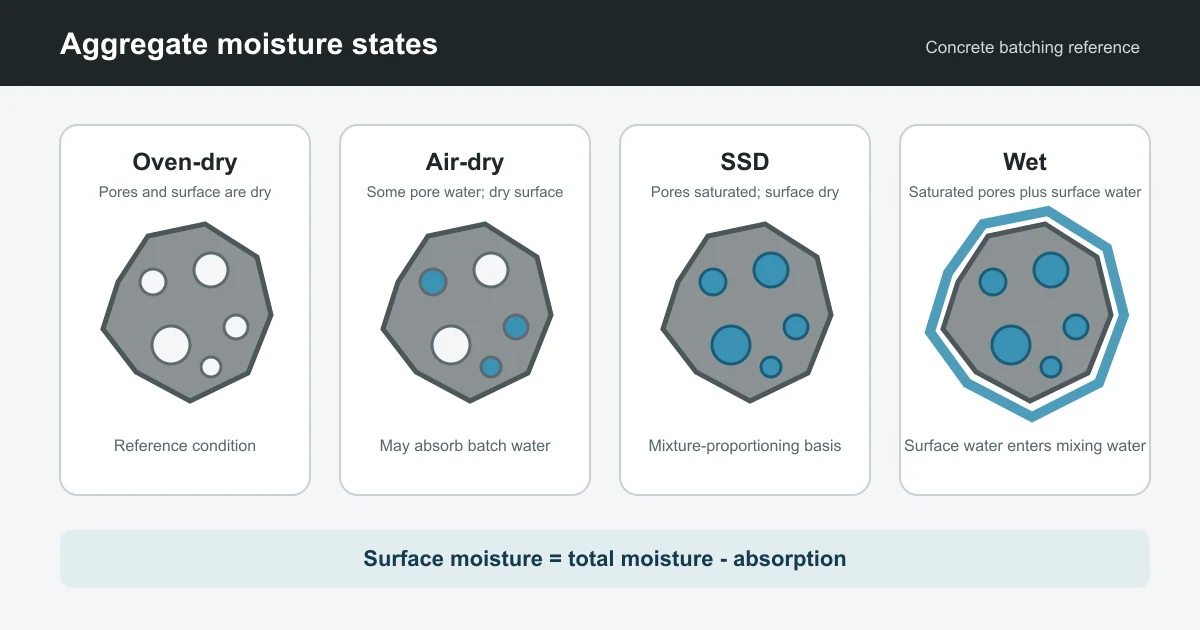
The four moisture states
- Oven-dry (OD)
- Pore water and surface water have been removed by the defined drying procedure. Absorption and moisture percentages are normally referenced to this dry mass.
- Air-dry
- Some pore water may remain, but the aggregate is below SSD. It can absorb part of the batch water.
- Saturated surface-dry (SSD)
- Permeable pores are filled while the surface is dry. SSD is the usual reference condition for mixture proportions.
- Wet
- Pores are saturated and free water is present on the surface. That surface water becomes part of the concrete mixing water.
Use one consistent calculation basis
Let:
- WSSD = aggregate mass in the approved mixture at SSD condition;
- A = absorption as a decimal fraction of oven-dry mass; and
- M = measured total moisture as a decimal fraction of oven-dry mass.
The equivalent oven-dry mass is:
WOD = WSSD ÷ (1 + A)
The actual aggregate mass to batch at the measured moisture condition is:
Wbatch = WOD × (1 + M)
The aggregate’s surface-water contribution is:
Wsurface water = WOD × (M − A)
- If M > A, surface water is positive: reduce the water added through the water system by that mass.
- If M < A, the value is negative: the aggregate is below SSD and the corresponding absorption water must be supplied, subject to the approved batching procedure.
- If M = A, the aggregate is at SSD for calculation purposes.
Worked calculation
Assume a mixture requires 1,000 kg of a coarse aggregate on an SSD basis. Its absorption is 1.0%, and its measured total moisture is 3.0%. Percentages are converted to decimals before calculation.
- WOD = 1,000 ÷ 1.01 = 990.1 kg
- Wbatch = 990.1 × 1.03 = 1,019.8 kg
- Surface water = 990.1 × (0.03 − 0.01) = 19.8 kg
The plant batches approximately 1,019.8 kg of that wet aggregate and reduces the separately added water by approximately 19.8 kg. Rounding, scale resolution, approved tolerances, and the treatment of every aggregate fraction must follow the production procedure.
Why correcting only the water is incomplete
If wet aggregate is weighed at the SSD target mass without correcting the aggregate batch weight, the batch contains less dry aggregate solids than intended. Conversely, dry aggregate weighed at the SSD target mass contains more dry solids and may absorb mixing water. A complete correction therefore addresses:
- the actual mass of each aggregate fraction; and
- the corresponding adjustment to water added elsewhere in the batch.
Measurement and plant-control workflow
- Confirm the basis. Verify that absorption and total moisture are expressed on the same oven-dry basis and that the approved mixture uses SSD aggregate masses.
- Sample each fraction responsibly. A sample must represent the material being batched, not an isolated wet or dry pocket.
- Measure current moisture. Use an appropriate test method and record the sample time, source, fraction, result, and person responsible.
- Calculate both corrections. Update aggregate mass and water contribution for every affected fraction.
- Check probe calibration. Continuous or in-bin moisture sensors are process tools; compare and calibrate them against the reference procedure at an appropriate frequency.
- Record changes. Keep the measured values, corrections, batch time, and any authorised manual adjustment traceable.
- Verify concrete response. Review fresh and hardened results without treating slump alone as proof that water correction was accurate.
Common errors
- Using total moisture as though all of it were free surface water.
- Subtracting absorption from moisture values expressed on a different mass basis.
- Correcting added water but leaving aggregate batch masses unchanged.
- Applying one moisture result to different aggregate fractions.
- Relying on a stale sample after rainfall, drainage, stockpile turnover, or production interruption.
- Changing the target mixing water to chase slump without diagnosing temperature, time, absorption, air, admixture response, or testing variability.
- Failing to include authorised jobsite water or other water-bearing additions in the total-water record.
When to increase measurement frequency
Increase checks when material or conditions are changing: after precipitation, during rapid drying, after stockpile replenishment or movement, when drainage conditions change, after a sensor discrepancy, following an unexplained shift in yield or workability, or whenever the quality plan requires closer control. The required frequency is a project and production-control decision, not a universal number.
Authoritative references
- American Concrete Institute — adjusting mixture proportions for aggregate moisture
- American Concrete Institute — free or surface water in aggregates
- American Concrete Institute — corrected aggregate batch weight
- American Concrete Institute — Aggregates for Concrete (E1)
- National Ready Mixed Concrete Association — TIP 6: Aggregate Moisture and Making Adjustments to Concrete Mixtures
- ASTM International — ASTM C566, Total Evaporable Moisture Content of Aggregate by Drying
Practical review checklist
- Are SSD, absorption, and moisture bases clearly defined?
- Is every aggregate fraction measured and corrected separately?
- Are both aggregate mass and added water corrected?
- Are sensor results checked against the reference method?
- Are values current enough for the stockpile and weather conditions?
- Are manual changes authorised, recorded, and included in total water?
- Do trial and production records confirm repeatable performance?