Technical notice: This article provides general technical information, not a project specification, purchase agreement, acceptance decision, or mixture-change instruction. The governing project documents determine the required aggregate specification, sampling plan, test methods, limits, frequency, authority, and response to nonconforming results. Verify current editions and project applicability before using any standard designation. Changes to aggregate source, processing, grading, moisture, or concrete mixture proportions should be evaluated by qualified personnel using representative data and trials.
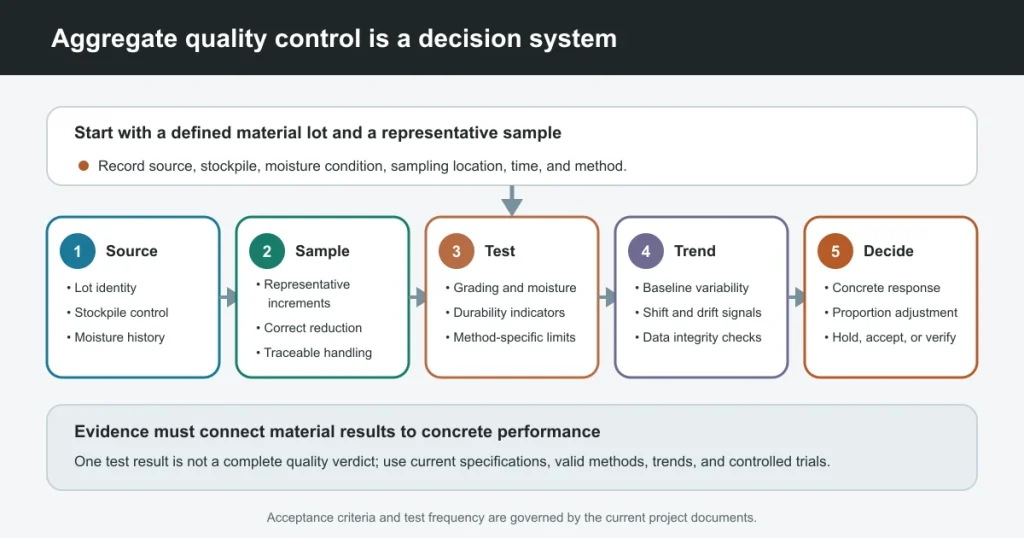
Aggregate quality control is not a single laboratory result. It is a connected process that begins with source evaluation and representative sampling, continues through production and stockpile control, and ends with concrete performance data. Aggregate properties and handling can influence both fresh-concrete behavior and hardened-concrete performance, while weak control procedures can create batch-to-batch and day-to-day variation.[1]
The practical objective is not to label an aggregate “good” or “bad” from one number. It is to determine whether the material is sufficiently consistent and suitable for the intended concrete, exposure, production system, and placement method. The following ten decisions provide a disciplined framework.
1. Treat representative sampling as part of the test
A precise test on an unrepresentative sample produces a precise answer to the wrong question. Sampling should capture the material condition that the decision is intended to represent: a source, production interval, delivery lot, moving stream, stockpile, or other defined unit.
ASTM D75/D75M emphasizes that sampling is as important as testing and that the sample should show the nature and condition of the material represented.[2] A few shovelfuls from an accessible stockpile surface may overrepresent one particle size or moisture condition because stockpiling and handling can segregate aggregate.
The field sample is usually larger than the test portion. ASTM C702/C702M provides procedures for reducing a large aggregate sample while minimizing changes in measured characteristics.[3] Mechanical splitting or another method permitted by the governing procedure is preferable to casually selecting a few handfuls. Rare oversized particles or low-frequency contaminants require particular care because sample reduction can include or exclude them by chance.
For every result, retain enough traceability to answer:
- What material and lot did the sample represent?
- Where and when was it taken?
- How many increments were combined?
- Who sampled and reduced it?
- Which method and equipment were used?
- Was the material visibly segregated, wet, contaminated, or changing?
2. Put the control and acceptance system in writing
Supplier control, purchaser acceptance, and troubleshooting samples do not necessarily serve the same purpose. Disputes often arise when parties sample at different locations or times—for example, beneath a conveyor at the source versus from a delivered stockpile—and then compare the results as though the samples represented identical material.
A purchase or project quality plan should define, at minimum:
- the lot or acceptance unit;
- sampling location, timing, frequency, and increment count;
- sample mass, reduction, sealing, identification, and retention;
- the responsible sampler and witness arrangements;
- test methods, laboratory requirements, and reporting precision;
- acceptance, conditional-use, retest, and rejection rules;
- the process for resolving conflicting results; and
- the authority to change aggregate blending or concrete mixture proportions.
ASTM C33/C33M is an internationally used specification for normalweight concrete aggregates, but it is not a universal project specification. It explicitly allows project-specific selection of quality, nominal maximum size, and grading requirements, and it assigns mixture-proportioning decisions to the responsible parties.[4] The governing document may instead use another national, regional, or owner standard.
3. Evaluate fine aggregate beyond the grading curve
Fine aggregate grading matters, but particle shape, surface texture, mineralogy, cleanliness, and the nature of the fines also affect performance. Rounded, smooth particles generally pack and move differently from angular, rough particles. With other variables held constant, a more angular or rough fine aggregate can increase void content, mixing-water demand, or paste demand for a target workability.[1,5]
That does not make manufactured sand inherently unsuitable, nor does it make natural sand automatically superior. A manufactured fine aggregate can perform well when its grading, particle shape, fines, mineralogy, and consistency are controlled and the concrete mixture is proportioned for the actual material. Likewise, a natural sand can contain harmful impurities or vary enough to disrupt production.
ASTM C1252 measures uncompacted void content under defined conditions and can indicate differences associated with particle shape, surface texture, and grading.[5] The result is method- and grading-dependent. It should support a broader evaluation, not replace concrete trials.
Useful questions include:
- Is the grading stable across the production range?
- Are changes concentrated on particular sieves?
- Are the fines mineral filler, clay-like material, or another constituent?
- Does the aggregate change concrete water demand, cohesion, bleeding, pumpability, or finishability?
- Are the same moisture basis and test method used when trends are compared?
4. Match coarse aggregate shape and size to the concrete system
Coarse aggregate should be evaluated as part of the complete concrete and placement system. Particle angularity, surface texture, flatness, elongation, grading, nominal maximum size, and packing can affect workability, paste demand, consolidation, pumpability, and hardened behavior.[1]
Strong universal statements such as “rounded is always better” or “crushed is always stronger” are unsafe. Angular particles can increase interlock and bond under some conditions, but they can also increase water or paste demand. Rounded particles may improve mobility, yet performance still depends on grading, mineralogy, strength, surface condition, and the selected water-to-cementitious materials ratio (w/cm).
Nominal maximum size must also be compatible with member geometry, reinforcement spacing, embedded items, placement openings, pump line, and consolidation method. Larger aggregate can reduce required paste in some mixtures, but it is not automatically suitable for congested or thin elements. The decision should be confirmed with applicable dimensional limits and representative trial batches.
5. Trend the full grading—not only fineness modulus
Fineness modulus (FM) is an index derived from sieve analysis. It is useful for tracking whether a fine aggregate is becoming relatively finer or coarser, but it does not describe the full particle-size distribution. Two materials can have similar FM values and different distributions across individual sieves.
A decrease in FM may coincide with greater surface area and different water or paste demand. An increase may reduce the fine fraction needed for cohesion and finishing. The actual effect depends on the complete grading, particle shape, fines, other aggregate fractions, and concrete mixture.
Do not import a universal FM-change trigger into a project without verifying its source and scope. The action limit should come from the governing specification, approved baseline, and demonstrated production response. When a trigger is exceeded, review the sieve-by-sieve change and run the authorized mixture-proportioning response rather than correcting slump with unrecorded water.
A useful control chart tracks FM alongside key sieve percentages, aggregate moisture content, concrete water adjustment, slump or flow, air content, density or yield, and strength results. A trend is more informative when it connects material change to concrete response.
6. Use sand equivalent as an indicator, not a complete quality score
The sand equivalent (SE) test assigns an empirical value related to the relative amount and character of clay-like material in the tested fine fraction. ASTM D2419 describes it as a rapid field correlation test and notes that other methods may be needed when clean dust of fracture is present.[6]
SE can therefore help detect a change in a source or process, but it does not by itself establish that a fine aggregate is suitable for concrete. A high value does not prove ideal grading, particle shape, durability, absorption, or concrete performance. A low value does not identify the mineralogy or harmfulness of the fines without further evidence.
Use an SE acceptance limit only when the governing specification requires it and the limit is appropriate for the material and end use. For internal control, trend the result against wash-sieve data, mineralogical or clay-sensitive testing where needed, and actual concrete performance.
7. Interpret sulfate soundness as a physical weathering indicator
ASTM C88/C88M exposes aggregate to repeated sodium sulfate or magnesium sulfate solution and drying cycles. Salt crystallization and rehydration within permeable pore spaces create expansive physical action. The method provides a preliminary estimate of aggregate soundness under weathering action.[7]
The word “sulfate” can be misleading. This test is not a direct evaluation of chemical sulfate attack on the cementitious matrix. It also does not reproduce a complete freezing-and-thawing exposure. ASTM cautions that its precision is limited and that outright rejection may require confirmation using evidence more closely related to the intended service.[7]
Interpret soundness results with the governing specification, aggregate type, salt used, petrography, absorption, documented field performance, and exposure. A single percent-loss result is one input to a durability decision, not a complete durability verdict.
8. Keep Los Angeles aggregate degradation separate from concrete abrasion
The Los Angeles (LA) test evaluates coarse aggregate resistance to degradation through abrasion and impact in a rotating drum. ASTM C131/C131M applies to defined small-size coarse aggregate, while ASTM C535 covers large-size coarse aggregate.[8,9]
The result is an aggregate property under a specific test. It is not a direct measurement of abrasion resistance of a finished concrete floor, pavement, or industrial surface. Surface performance also depends on the concrete mixture, w/cm, bleeding, consolidation, finishing timing and method, curing, surface treatment, and service loading.
ASTM also cautions against automatically comparing sources with substantially different origin, composition, or structure solely from LA loss.[8,9] Use the correct method and grading, compare results within an appropriate material context, and verify any project limit before making an acceptance decision.
9. Assess alkali-silica reaction risk as a system
Alkali-silica reaction (ASR) can develop when susceptible siliceous aggregate, sufficient alkalinity, and sufficient moisture occur together. The reaction product can expand in the presence of moisture and contribute to cracking and loss of serviceability. Visible map cracking alone does not prove ASR; diagnosis may require petrography and other evidence.[10,11]
No single test answers every ASR question:
- ASTM C1260 is an accelerated mortar-bar method for detecting potential aggregate reactivity. Its conditions do not represent concrete in service, and it does not evaluate the actual combination of aggregate and cementitious materials.[10]
- ASTM C1293/C1293M uses concrete prisms to evaluate aggregate susceptibility or a tested aggregate–pozzolan/slag combination under prescribed laboratory conditions. Those conditions still differ from field exposure.[10]
- ASTM C1567 evaluates combinations of cementitious materials and aggregate using an accelerated mortar-bar procedure.[10]
- ASTM C1778 provides a risk framework that considers aggregate reactivity, exposure—especially moisture—structure criticality, concrete alkali availability, and preventive measures.[10]
Potential controls include selecting a nonreactive aggregate, controlling concrete alkali loading, and using an effective quantity of suitable supplementary cementitious materials (SCMs) or other validated measures. Do not assume that any SCM type or arbitrary replacement level will control every aggregate. Demonstrate effectiveness using the governing method and the actual materials.
10. Accept field history only when the comparison is valid
Documented field performance can be valuable, but “we have used this aggregate for years” is not enough. A credible comparison should connect the aggregate source and processing history to known concrete materials, mixture proportions, alkali loading, exposure, moisture, age, and observed condition.
ACI PRC-221.2-24 describes a combined program involving field observations, sampling, petrographic evaluation, and comparison of historic and current material characteristics.[11] ASTM C1778 likewise recognizes appropriately verified field performance within an ASR risk assessment.[10]
Reevaluate the evidence when any important variable changes, including:
- quarry bench, geological layer, or processing route;
- fine or coarse aggregate blend;
- cement or SCM source and quantity;
- concrete alkali loading;
- aggregate moisture or absorption behavior;
- member exposure, drainage, or moisture availability; or
- project criticality and acceptable risk.
Field history is strongest when it is documented, comparable, and used with—not instead of—current material characterization and testing.
Build an aggregate control plan around decisions
An effective control plan connects a measured change to a predefined action. A compact framework is shown below.
| Control area | Record | Decision question | Typical controlled response |
|---|---|---|---|
| Source and processing | source, bench, crusher settings, wash circuit, production interval | Did the material-producing process change? | segregate the lot, increase verification, review baseline |
| Sampling | lot, location, time, increments, sampler, reduction method | Does the sample represent the decision unit? | resample before accepting or rejecting |
| Grading | full sieve distribution and FM | Is the change isolated or systematic? | review blending and mixture proportions |
| Moisture and absorption | total moisture, absorption basis, surface moisture | Is batch water being corrected on a consistent basis? | update approved batch corrections and verify records |
| Shape, texture, and fines | void content, visual trend, appropriate fines tests | Did water or paste demand change? | run representative concrete trials |
| Physical durability | soundness, LA degradation, petrography, service history | Is the method relevant to the exposure and particle size? | confirm with governing requirements and supporting evidence |
| ASR | field history, petrography, expansion tests, materials and exposure | Is the aggregate–concrete–exposure system adequately controlled? | use the approved risk and mitigation framework |
| Concrete response | workability, air, density/yield, strength, durability indicators | Did the material change affect the finished system? | investigate cause; approve changes through the defined authority |
Aggregate moisture deserves its own live production control because wet aggregate contributes surface water and aggregate below saturated surface-dry condition can absorb part of the mixing water. For the calculation basis and a worked control method, see Aggregate Moisture and Batch-Water Corrections in Concrete.
A disciplined response to a changed result
When a test or trend moves outside its normal range:
- Confirm identity and traceability. Verify source, lot, sample, method, equipment, units, and data entry.
- Check representativeness. Review segregation, sample location, increment count, and reduction method.
- Repeat only under a defined rule. Do not retest until a favorable number appears.
- Compare the complete trend. Examine related grading, moisture, fines, production, and concrete data.
- Identify the earliest change point. Source, processing, weather, stockpile, blend, or test practice may have shifted.
- Evaluate concrete response. Use controlled trials when the material change can affect mixture proportions or placement.
- Apply the governing disposition. Acceptance, conditional use, reprocessing, blending, or rejection requires defined authority.
- Document the decision. Preserve evidence, rationale, approvals, and the effect on subsequent production.
Frequently asked questions
Is a well-graded aggregate always sufficient for good concrete?
No. Grading is important, but shape, texture, moisture, absorption, mineralogy, deleterious constituents, durability, alkali-silica reaction potential, mixture proportions, production, and placement also matter.
Does a higher sand equivalent always mean better fine aggregate?
No. Sand equivalent is an empirical indicator of clay-like fines under a defined method. It does not measure complete fine aggregate quality or concrete performance.
Does a low Los Angeles loss guarantee an abrasion-resistant concrete floor?
No. The Los Angeles test measures aggregate degradation under its test conditions. Concrete surface abrasion depends on the complete material and construction system.
Can long service history replace current alkali-silica reaction evaluation?
Only when the history is documented and genuinely comparable, and when the governing risk framework permits its use. Changes in materials, alkali loading, exposure, or source conditions can invalidate a simple historical comparison.
What should happen when an aggregate test result changes unexpectedly?
First confirm material identity, traceability, sampling, specimen reduction, preparation, calculation, units, and equipment status. Then compare the result with recent trends and concrete response, determine whether the change is real, and follow the written authority and disposition process rather than repeatedly testing until a favorable result appears.
Final perspective
Reliable concrete begins with consistent constituent materials, but consistency is created by a system: representative sampling, correct test methods, source and stockpile control, traceable data, trend analysis, and authorized responses. The most useful aggregate quality-control program does not collect isolated numbers. It connects each result to the concrete decision it is meant to support.
Technical references
The editions below were checked on official publisher pages on 2026-08-01. Reverify the active edition and project applicability before publication or use.
- American Concrete Institute, ACI PRC-221-25: Use of Normalweight and Heavyweight Aggregates in Concrete—Guide
- ASTM International, ASTM D75/D75M-19(2026): Standard Practice for Sampling Aggregates
- ASTM International, ASTM C702/C702M-24: Standard Practice for Reducing Samples of Aggregate to Testing Size
- ASTM International, ASTM C33/C33M-24a: Standard Specification for Concrete Aggregates
- ASTM International, ASTM C1252-23: Standard Test Methods for Uncompacted Void Content of Fine Aggregate
- ASTM International, ASTM D2419-22: Standard Test Method for Sand Equivalent Value of Soils and Fine Aggregate
- ASTM International, ASTM C88/C88M-24: Standard Test Method for Soundness of Aggregates by Use of Sodium Sulfate or Magnesium Sulfate
- ASTM International, ASTM C131/C131M-20: Standard Test Method for Resistance to Degradation of Small-Size Coarse Aggregate by Abrasion and Impact in the Los Angeles Machine
- ASTM International, ASTM C535-16(2024): Standard Test Method for Resistance to Degradation of Large-Size Coarse Aggregate by Abrasion and Impact in the Los Angeles Machine
- ASTM International, Subcommittee C09.50 active aggregate-reaction standards, including C1260-23, C1293/C1293M-23ae1, C1567-25, and C1778-25
- American Concrete Institute, ACI PRC-221.2-24: Use of Field Performance History in Evaluating Alkali-Silica Reactivity Potential of Concrete—TechNote