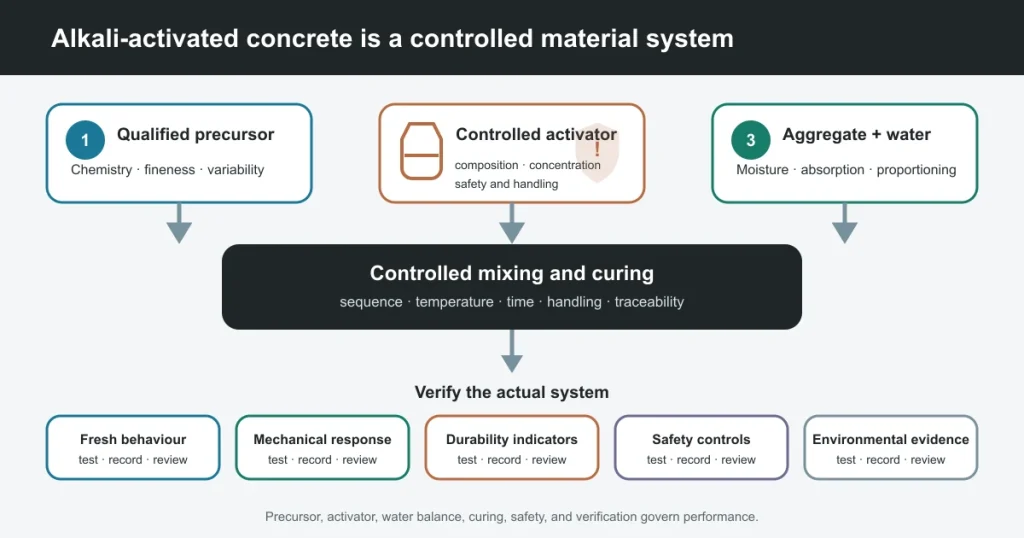
Technical Notice: This article provides general technical information, not a mixture specification, structural design, environmental declaration, or safety procedure. Alkali-activated materials vary widely. Selection, handling, mixture proportions, curing, durability verification, code compliance, and environmental claims must be established for the actual constituents, production process, exposure, and governing documents by qualified professionals. Concentrated alkaline activators can cause severe injury and require a project-specific safety system.
Geopolymer concrete is part of a broader family of concretes made with alkali-activated cementitious materials. Instead of relying only on conventional portland cement hydration, these binders use an alkaline activator to react with suitable precursors such as slag, fly ash, metakaolin, or combinations of aluminosilicate materials.
The technology is not one recipe. Chemistry, calcium content, activator composition, curing temperature, water, aggregate, admixtures, and production sequence can produce very different fresh and hardened properties. A statement that is true for a heat-cured, low-calcium fly-ash geopolymer may not apply to an ambient-cured slag-rich alkali-activated concrete.
Geopolymer or alkali-activated material?
The terms overlap but are not exact synonyms. Alkali-activated cement is the broader technical category used by ACI PRC-242-22 and ASTM C1948/C1948M-24. “Geopolymer” is commonly used for systems in which aluminosilicate precursors form highly cross-linked reaction products, often associated with low-calcium materials. Calcium-rich activated slag systems can form different binding phases and are often described more accurately as alkali-activated materials.
For specifications, reports, and test records, identify the actual binder rather than relying on the word “geopolymer.” Record precursor sources, chemical and physical characteristics, activator constituents and concentration, solids content, water basis, admixtures, curing, and age.
The main constituents
Precursors
Precursors supply reactive silica, alumina, calcium, and other components. Common examples include:
- ground granulated blast-furnace slag;
- coal fly ash of a suitable and consistent source;
- calcined clay or metakaolin;
- natural pozzolans; and
- qualified blends of these materials.
Availability does not establish suitability. Particle size, glass content, mineralogy, calcium, reactive silica and alumina, loss on ignition, contaminants, and source variability can affect reaction rate and performance. Industrial by-products may change when the upstream process or supply chain changes.
Alkaline activators
Two-part systems commonly combine a precursor with an alkaline solution, which may contain alkali hydroxides, silicates, carbonates, or other activator components. One-part systems incorporate solid activator constituents so that water is added during mixing. “Just add water” does not eliminate chemical risk; dust, dissolution, heat release, and high-pH pore solution still require assessment.
The activator is not a generic dose. Alkali content, silicate modulus, concentration, liquid-to-binder ratio, added water, and interaction with the precursor influence workability, setting, strength development, shrinkage, efflorescence, and durability.
Aggregates, water, and admixtures
Aggregates perform the same volume-stabilizing and load-transfer roles they do in other concrete, but the binder chemistry can change aggregate compatibility. The total water basis must be defined consistently because activator solutions already contain water. Conventional chemical admixtures may not behave the same way in a highly alkaline, non-portland system. Compatibility trials are essential.
How the binder develops
Alkaline activation generally involves dissolution of reactive precursor species, transport and reorganization in solution, and precipitation or polymerization of binding phases. The dominant products depend strongly on precursor chemistry. Low-calcium aluminosilicate systems and calcium-rich slag systems should not be assumed to follow the same reaction path.
Temperature can accelerate reaction and strength development, but required curing varies. Some fly-ash systems have historically relied on elevated-temperature curing, making them attractive for precast production. Other blends can develop useful properties at ambient temperature. The necessary curing regime must be demonstrated, not inferred from the material name.
Fresh-concrete performance
Workability, setting, heat evolution, air, bleeding, and finishability can differ substantially from conventional concrete. Highly viscous activator solutions, rapid reaction, precursor fineness, and temperature may reduce workability retention. Extra water added to regain consistency can alter the designed chemistry and hardened performance.
Production trials should reproduce:
- constituent temperature and order of addition;
- actual mixer type, energy, and batch size;
- activator preparation and cooling time;
- transport and discharge duration;
- admixture sequence;
- placement and consolidation method;
- curing temperature and moisture; and
- laboratory and field test timing.
Fresh-property test methods developed for conventional concrete may still be useful, but their applicability and interpretation should be confirmed for the system.
Strength and dimensional stability
Alkali-activated concrete can be proportioned for a wide range of strength-development profiles. Some systems achieve high early strength; others react slowly at low temperature. It is inaccurate to state that geopolymer concrete is always stronger than portland-cement concrete or that a fixed percentage of ultimate strength is reached by a specific age.
Shrinkage and creep are also formulation-dependent. Slag-rich binders may show substantial autogenous or drying shrinkage in some conditions, while other systems perform differently. Strength alone does not establish cracking resistance. Verify elastic modulus, tensile or flexural response, shrinkage, creep, thermal movement, bond, and restraint effects as relevant to the application.
ASTM C1928/C1928M-25a provides a current mortar compressive-strength method for alkali-activated cementitious materials. Concrete-level qualification still requires project-relevant specimens, curing, and acceptance procedures.
Durability must be exposure-specific
Dense microstructure or low absorption in one test does not prove universal durability. ACI PRC-242-22 highlights properties and technical challenges across alkali-activated systems. Important questions include:
- resistance to carbonation and its effect on reinforcement protection;
- chloride transport and corrosion initiation;
- freezing-and-thawing performance and air-void stability;
- sulfate, acid, seawater, or industrial chemical exposure;
- alkali–aggregate reaction risk;
- efflorescence and alkali leaching;
- elevated-temperature and fire response;
- long-term shrinkage, creep, and cracking; and
- compatibility with reinforcement, fibres, coatings, sealants, and repair materials.
Test conditioning can interact with chemistry. A method calibrated around portland-cement concrete may require technical review before its result is used as an acceptance limit for an alkali-activated system. Record specimens, curing, age, preconditioning, exposure solution, units, and uncertainty.
Potential applications
Alkali-activated and geopolymer concretes have been investigated or used in:
- precast elements where controlled curing is available;
- pavement and infrastructure demonstrations;
- rapid-repair and high-early-strength materials;
- masonry units, blocks, pavers, and architectural products;
- heat- or chemical-resistant applications with system-specific evidence; and
- conventional cast-in-place work when ambient curing and delivery have been qualified.
Application suitability depends on codes, supply consistency, production safety, design data, durability evidence, contractor capability, and inspection. A demonstration project is not proof that the same formulation is appropriate for a different exposure or structural system.
Environmental performance: calculate, do not assume
Using an industrial by-product or less portland cement can reduce some environmental burdens, but “cement-free” does not automatically mean low carbon. Impacts can come from precursor processing, activator production, transport, heat curing, yield, waste, service life, and end-of-life treatment. Sodium silicate and hydroxide production can be significant contributors.
Compare functionally equivalent systems using a declared boundary, verified inventory, consistent service life, and preferably third-party environmental product declarations or a project-specific life-cycle assessment. Do not transfer a carbon-reduction percentage from a different formulation or region.
Safety and production controls
Concentrated alkaline solutions can be corrosive to skin and eyes, may release heat when prepared, and can react with incompatible materials. A safety plan should cover procurement, storage, secondary containment, automated or closed dosing, ventilation, temperature control, personal protective equipment, eyewash and emergency facilities, spill response, training, and waste management. The safety data sheets and applicable occupational rules govern.
Quality control should include traceability of precursor and activator lots, solution concentration or solids, water balance, calibration, batch temperature, mixing sequence, fresh properties, curing, and test results. Automated dosing may reduce exposure and variability, but it does not replace verification.
A qualification workflow
- Define performance, exposure, design life, governing rules, and acceptance methods.
- Characterize precursor and activator sources and expected variability.
- Establish a consistent mass and water balance, including solution water.
- Screen fresh properties, setting, heat release, strength, and dimensional stability.
- Test the controlling durability mechanisms under representative curing and exposure.
- Verify reinforcement, admixture, coating, sealant, and repair compatibility.
- Complete an environmental and safety assessment using actual supply data.
- Scale up through plant trials and full-size mock-ups.
- Define production limits, corrective actions, and change-control rules.
- Monitor field performance and retain samples and records where justified.
Frequently asked questions
Is every alkali-activated concrete a geopolymer?
No. Alkali-activated cementitious materials are a broad family. “Geopolymer” is best reserved for systems whose chemistry and reaction products support that description.
Is geopolymer concrete always cement-free?
No. Some formulations contain no portland cement; others are hybrid systems containing portland cement, slag, or additional binders. State the actual composition.
Is geopolymer concrete automatically lower carbon and more durable?
No. Both claims depend on the constituents, activator, curing, transport, exposure, service life, and calculation or test method. They require system-specific evidence.
Related reading
- Concrete Durability: Exposure, Transport, Materials, and Execution
- Water-Reducing Admixtures in Concrete
- Explore concrete materials expertise
Technical references
- American Concrete Institute, ACI PRC-242-22—Alkali-Activated Cements: Report: https://www.concrete.org/Portals/0/Files/PDF/Previews/242-22_preview.pdf
- ASTM International, ASTM C1948/C1948M-24—Standard Specification for Alkali-Activated Cementitious Materials: https://store.astm.org/c1948_c1948m-24.html
- ASTM International, Subcommittee C01.14—Non-hydraulic Cements (including active ASTM C1928/C1928M-25a): https://www.astm.org/membership-participation/technical-committees/committee-c01/subcommittee-c01/jurisdiction-c0114
- Federal Highway Administration, TechBrief: Geopolymer Concrete: https://www.fhwa.dot.gov/pavement/concrete/pubs/hif10014/hif10014.pdf
- American Concrete Institute, A Step Toward Practical Geopolymer Concrete: https://www.concrete.org/publications/internationalconcreteabstractsportal.aspx?id=51710891&m=details