Technical Notice: This article provides general technical information, not a structural design, optical calculation, fire classification, product specification, or energy-saving guarantee. Proprietary light-transmitting concrete products vary. Structural capacity, anchors, fire, durability, optical performance, weathering, accessibility, and code compliance must be verified for the selected product and complete assembly by qualified professionals.
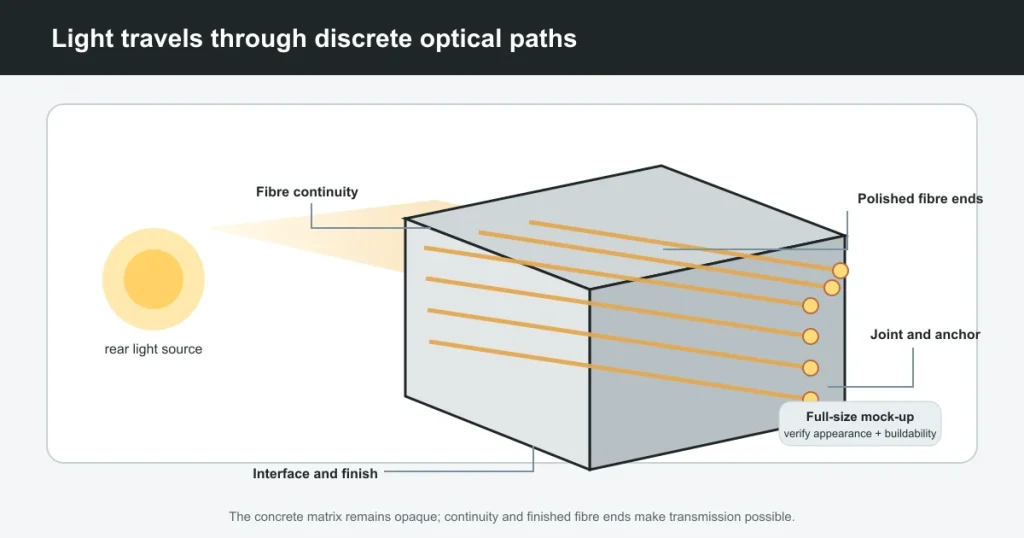
Light-transmitting concrete is a cementitious composite that contains continuous light-conducting paths between two faces. Most familiar systems use aligned glass or polymer optical fibres embedded in a fine concrete or mortar matrix. From one side, the panel can look like dense concrete; when the opposite side is illuminated, points or silhouettes of light appear on the viewing face.
The material is often called translucent concrete or optical-fibre concrete. It is not transparent in the way glass is. The concrete matrix remains opaque; light travels through discrete fibres or other optical elements. Litracon® is a proprietary product and trademark, not a generic name for every light-transmitting concrete.
How light crosses an opaque matrix
An optical fibre guides light along its length. When many fibres run from one panel face to the other, each fibre acts as a small light path. The visible result depends on:
- fibre material, diameter, spacing, and numerical aperture;
- alignment and continuity through the panel;
- panel thickness and fibre length;
- incident-light direction, intensity, and spectrum;
- quality of the cut and polished fibre ends;
- surface finish, contamination, and weathering; and
- the viewing distance and contrast on both sides.
The fibres do not make the surrounding concrete transparent. A person or object near the illuminated face can interrupt light reaching some fibre ends, producing a silhouette on the opposite face.
The Litracon reference
Áron Losonczi’s patent family describes a building block containing light-transmitting fibres that extend between surfaces. The manufacturer’s current Litracon Classic® page identifies prefabricated blocks made from glass optical fibre and fine concrete. Those sources document one commercial implementation; they do not establish universal proportions or performance for products made by others.
Avoid repeating a fixed “96% concrete and 4% fibres” rule or a universal transmission distance. Commercial products, prototypes, and research specimens use different matrices, optical elements, geometry, and manufacturing methods. The selected product data and project tests are the relevant evidence.
Production approaches
Layered fibre placement
A common experimental approach alternates thin layers of fine concrete or mortar with aligned fibres. Fixtures hold the fibres in position while the matrix is placed and consolidated. After curing, the element is cut or ground so that the fibre ends are exposed on both faces, then polished.
The main challenges are maintaining fibre alignment, preventing floating or clustering, filling around the fibres without voids, and avoiding damage during consolidation and finishing. Excessive vibration can disturb the optical layout; insufficient consolidation can leave defects.
Preassembled fibre arrays
Fibres may be positioned in a grid or bundle before casting. A jig establishes spacing and keeps the paths continuous through the intended thickness. This can improve repeatability and enable patterns, but the fixture, fibre tension, and placement tolerances become critical production variables.
Alternative light-conducting elements
Some systems use larger polymer elements, transparent inserts, resins, or shaped light guides instead of many fine glass fibres. These are different composite systems with their own thermal movement, fire, ultraviolet, bond, and durability behavior. They should not be treated as equivalent merely because they transmit light.
Why fine concrete is often used
Closely spaced optical paths are easier to place in a fine matrix than around large coarse aggregate. The matrix must flow around fibres while remaining stable and compatible with the required finish. Workability should not be confused with excess water: a high water content can increase shrinkage, porosity, bleeding, and surface defects.
Mixture qualification should consider:
- aggregate size relative to fibre spacing and panel thickness;
- w/cm, paste volume, shrinkage, and cracking;
- workability and consolidation without segregation;
- heat development and curing;
- bond and chemical compatibility with the optical element;
- colour consistency and surface finish; and
- grinding and polishing response.
No general requirement exists to add an expansive admixture. Any shrinkage-control or expansive system should be selected for a defined performance target and validated for dimensional stability, cracking, fibre interface, and finish.
Mechanical and structural performance
Optical fibres create inclusions and interfaces in the matrix. Depending on their material, volume, orientation, and bond, they may change compressive strength, flexural response, fracture behavior, transport, and thermal properties. Research findings cannot be transferred between fibre layouts without qualification.
If a panel is only an interior decorative facing, its self-weight, anchors, impact, fire, and service movements still require design. If it is proposed as load-bearing structural concrete, the complete material and member must satisfy the governing structural code, including strength, serviceability, durability, reinforcement, fire, connections, quality control, and inspection. A visually successful prototype is not a structural qualification.
Test specimens should reproduce fibre orientation and panel manufacturing. A cube or cylinder taken from a fibre-free part of the matrix does not represent the complete composite. Sampling direction matters because aligned fibres make the material anisotropic.
Optical performance needs its own specification
“Lets light through” is not a measurable acceptance criterion. A project may need to specify luminous transmittance, image contrast, angular response, colour shift, uniformity, visible defects, and performance after conditioning. Define the light source, spectrum, geometry, panel thickness, surface state, sensor, background, and calculation method.
Full-size mock-ups are especially useful. They allow the team to evaluate daylight and artificial lighting, glare, privacy, silhouettes, nighttime appearance, joint lines, surface finish, and maintenance under realistic viewing conditions.
Durability and service-life questions
The concrete matrix and optical elements respond differently to moisture, temperature, alkalinity, ultraviolet exposure, and movement. Qualification should address:
- fibre or insert stability in the alkaline pore solution;
- differential thermal movement and interface cracking;
- freeze-thaw, wet-dry, salt, or chemical exposure where relevant;
- water entry at panel joints and anchors;
- surface abrasion and loss of polished fibre ends;
- ultraviolet exposure of polymer optical elements;
- cleaning products and graffiti-removal methods;
- fire and smoke performance of the complete assembly; and
- replacement access if optical performance degrades.
An optical fibre can continue to transmit light while the surrounding panel develops a structural or durability defect. Visual brightness is not a condition assessment.
Applications where the material can add value
Light-transmitting concrete is best considered where its visual effect supports a clear architectural function, such as:
- interior partitions and feature walls;
- façade or rainscreen panels with a designed backlight or daylight path;
- reception desks, counters, signage, and wayfinding;
- screens that reveal silhouettes while maintaining a concrete appearance;
- art installations, furniture, and lighting objects; and
- selected paving or landscape elements designed for the relevant load, slip, water, and maintenance conditions.
Claims of large energy savings require a building-level lighting and energy analysis. Transmitting some daylight does not automatically reduce annual energy use: orientation, climate, lighting controls, opening area, transmittance, heat flow, glare, occupancy, and electric-light efficiency all matter.
Design and procurement checklist
- Decide whether Litracon® or generic light-transmitting concrete is intended; respect trademarks and proprietary data.
- Define the architectural effect with full-size visual mock-ups.
- Specify panel dimensions, tolerances, finish, edge treatment, optical layout, and acceptable defects.
- Establish structural role, loads, anchors, joints, impact, fire, and movement criteria.
- Specify measurable optical properties and test geometry.
- Verify matrix, optical element, interface, weathering, cleaning, and environmental durability.
- Review fabrication capacity, quality records, repair procedures, spares, and replacement lead time.
- Coordinate lighting, wiring, access, drainage, condensation, and controls when backlighting is used.
- Inspect fibre continuity, voids, cracks, finish, dimensions, and anchor locations before acceptance.
- Document cleaning and maintenance methods that will not scratch or obscure the fibre ends.
Frequently asked questions
Is light-transmitting concrete actually transparent?
No. The cementitious matrix is opaque. Discrete optical paths carry light between faces, so “translucent” or “light-transmitting” is usually more accurate.
Does adding optical fibre leave concrete strength unchanged?
Not necessarily. Strength and fracture behavior depend on fibre material, volume, orientation, interfaces, matrix, curing, and specimen direction. Test the complete composite.
Does light-transmitting concrete automatically save energy?
No. Energy performance requires a project-specific daylight, lighting-control, thermal, and operational analysis. Architectural value may be the primary benefit.
Related reading
- The Interfacial Transition Zone in Concrete
- Concrete Durability: Exposure, Transport, Materials, and Execution
- Discuss a concrete technology application
Technical references
- Litracon Ltd., Litracon Classic®—official product page: https://litracon.hu/en/products/litracon-blokk
- European Patent Office, EP1532325B2—Building block comprising light-transmitting fibres and a method for producing the same: https://data.epo.org/publication-server/rest/v1.0/publication-dates/20140611/patents/EP1532325NWB2/document.pdf
- Litracon Ltd., Official product flyer: https://www.litracon.hu/uploads/documents/Litracon_flyer_2016.pdf
- American Concrete Institute, ACI CODE-318-25—Building Code for Structural Concrete: https://www.concrete.org/topicsinconcrete/318buildingcodeportal.aspx
- Luhar et al., Light Transmitting Concrete: A Review, Buildings (2021): https://www.mdpi.com/1313812
- Bai et al., Development of Optical Fiber Light-Transmitting Concrete (LTC)—A Review, Buildings (2025): https://www.mdpi.com/2075-5309/15/1/104