Technical Notice: This article provides general technical information, not a condition assessment, safety decision, repair design, or remaining-capacity evaluation. Cracking, delamination, leakage, corrosion, displacement, or falling concrete can indicate a hazardous condition. Restrict access where appropriate and obtain prompt assessment by qualified professionals. Tests and repairs must follow the actual structure, exposure, governing code, and approved documents.
“Concrete cancer” is an informal phrase, not a defined deterioration mechanism. It is often used for cracking and spalling associated with reinforcement corrosion, but it may also be applied loosely to alkali–silica reaction, chemical attack, freeze-thaw damage, or other progressive distress.
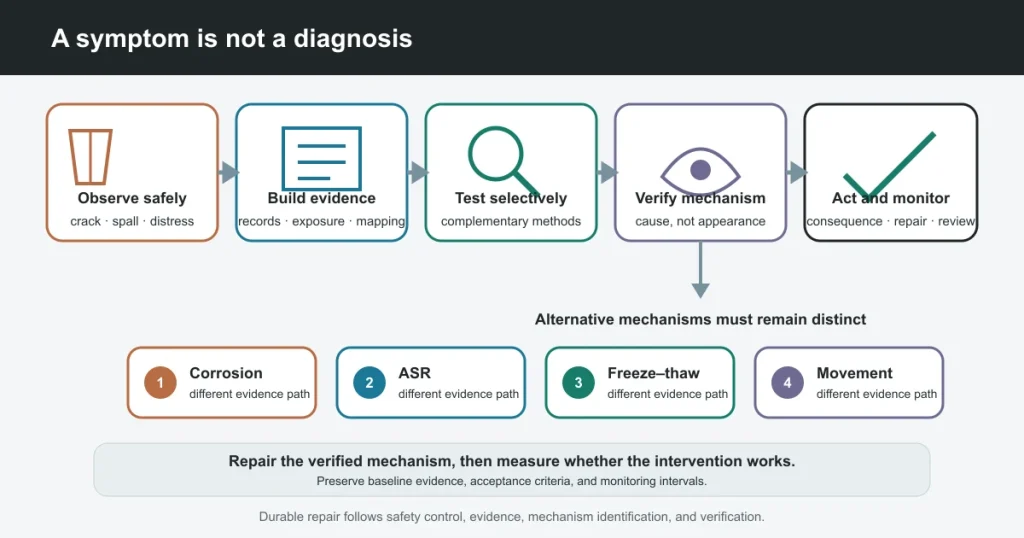
That ambiguity matters. A surface symptom does not identify its cause, and different mechanisms need different repairs. The defensible sequence is:
make the area safe → document symptoms and history → develop hypotheses → test to distinguish mechanisms → evaluate consequences → design and verify the intervention.
Damage, deterioration, and defect are not the same
A defect may originate in design or construction, such as honeycombing, inadequate cover, a misplaced joint, or an unsealed penetration. Damage may result from impact, overload, fire, settlement, or an extreme event. Deterioration is a loss of condition or performance over time through physical, chemical, or electrochemical processes.
These categories can interact. A construction crack can admit chlorides; corrosion can expand and delaminate the cover; the resulting spall exposes more steel and changes moisture transport. A durable repair must address the initiating condition and the changed exposure, not just the visible surface.
Why reinforcement corrosion causes cracking and spalling
Steel embedded in sound concrete is normally protected by the highly alkaline pore solution and the surrounding cover. That protection can be compromised when carbonation reaches the steel or when sufficient chlorides are present at the reinforcement. Moisture and oxygen conditions then influence corrosion activity.
Corrosion products generally occupy more volume than the original iron consumed. The expansion can create tensile stress in the cover concrete, leading to longitudinal cracking, delamination, and spalling. At the same time, steel cross-section and bond may be reduced. The amount and form of corrosion product vary; a single universal expansion multiplier should not be used for assessment.
Rust staining, cracks following reinforcement, hollow-sounding areas, and spalls are warning signs, not a complete diagnosis. Hidden corrosion can exist before visible damage, while rust staining may originate from nonstructural metal or surface contamination.
Other mechanisms commonly confused with “concrete cancer”
Alkali–silica reaction
ASR involves reactive forms of silica in some aggregates, alkalis, and sufficient moisture. Expansive reaction products can cause internal cracking and movement. Map cracking alone does not prove ASR. FHWA guidance emphasizes that confirmed diagnosis requires evidence associated with reacting aggregate and, commonly, petrographic examination of cores.
Freezing and thawing
Concrete that becomes sufficiently saturated and experiences freezing can develop scaling or internal cracking. Aggregate-related distress, deicing chemicals, air-void system, drainage, and curing can affect the outcome. Cold climate alone is not a diagnosis.
Sulfate, acid, and other chemical attack
Different chemicals act through different mechanisms. External sulfate attack, acid dissolution, leaching, salt crystallization, and magnesium exposure should not be grouped as one “chemical crack.” Exposure chemistry, transport, mineralogy, and reaction products must be considered.
Physical and structural actions
Drying shrinkage, thermal movement, restrained volume change, settlement, overload, fatigue, abrasion, erosion, fire, and support movement can crack or remove concrete. A crack pattern may reflect more than one action.
When immediate controls are needed
Treat loose overhead concrete, sudden displacement, widening cracks, exposed or buckled reinforcement, impact damage, fire damage, unusual vibration, or signs of instability as potential safety issues. The owner’s emergency process may require barricades, catch platforms, unloading, shoring, monitoring, or evacuation. These controls must be designed and authorized; improvised shoring can introduce new hazards.
ACI CODE-562-25 provides current requirements for assessment, repair, and rehabilitation of existing concrete structures. It should be used with the code adopted for the project and the licensed design professional’s criteria.
A structured condition assessment
ACI PRC-364.1-19 frames assessment around agreed objectives, documentation, field observations, sampling, testing, evaluation, and reporting. A practical workflow follows.
1. Define the objective
The investigation may need to determine immediate safety, cause and extent of distress, structural capacity, leakage, durability, change of use, repair feasibility, or remaining service life. Tests selected for one objective may not answer another.
2. Build the history
Collect drawings, specifications, material records, construction changes, repairs, inspections, loads, environmental data, leaks, drainage changes, chemical exposure, fire or impact events, and maintenance. Establish when each symptom first appeared and how it changed.
3. Map the condition
Use a repeatable grid and reference system. Record crack location, orientation and width; spalls; delamination; leakage; staining; deformation; exposed reinforcement; joints; coatings; repairs; and moisture. Photographs should include scale and location.
4. Select complementary tests
No single test provides the complete answer. Depending on the hypotheses, the program may include cover measurement, delamination survey, crack monitoring, cores, compressive testing, carbonation depth, chloride profiles, electrical resistivity, corrosion potentials or rates, microscopy, petrography, and structural analysis.
ASTM C876/C876M corrosion-potential data require experienced interpretation and complementary information. The standard itself notes limitations related to electrical conditions, cover, moisture, temperature, and reinforcement type. A colour contour map is not a direct measurement of steel loss.
ASTM C856/C856M-25 provides current practice for petrographic examination of hardened concrete. Sampling location and orientation should be chosen to answer the investigation question and avoid unacceptable structural damage.
5. Connect evidence to mechanism and consequence
Separate observation from interpretation. For each hypothesis, state supporting and conflicting evidence, uncertainty, extent, likely progression, and consequences for capacity, serviceability, durability, and safety.
Repair selection: remove the cause, restore the function
A repair strategy can include one or more of the following:
- correcting drainage, leaks, joints, or exposure;
- removing unsound concrete and treating or replacing affected reinforcement;
- restoring section and bond with compatible repair materials;
- injecting selected cracks where the movement and objective allow;
- applying sealers, coatings, membranes, overlays, or barriers;
- using electrochemical corrosion-control methods;
- strengthening, adding support, or changing the load path; and
- replacing members or accepting monitored service under defined limits.
The right choice depends on mechanism, extent, geometry, moisture, movement, access, service interruption, compatibility, design life, appearance, and cost. A strong repair material is not automatically compatible. Modulus, shrinkage, thermal movement, permeability, bond, curing, and substrate preparation can control performance.
Partial-depth corrosion repairs can create electrochemical interactions at the boundary between repaired and unrepaired concrete. Repair limits, steel treatment, continuity, and corrosion-control strategy should be designed as a system.
Why common shortcuts fail
- Painting over rust stains conceals evidence without assessing corrosion.
- Patching only the loose area may leave active deterioration at the perimeter.
- Injecting every crack can lock in movement or redirect water.
- Using a higher-strength mortar can increase stiffness and shrinkage mismatch.
- Calling map cracks ASR without petrographic evidence can lead to the wrong intervention.
- Using one half-cell threshold as a verdict ignores method limitations and complementary data.
- Assuming a surface coating stops all moisture overlooks joints, cracks, back-side pressure, and vapour.
Prevention through a durability system
Prevention starts with exposure classification and water management. Design cover, crack control, joints, drainage, protective systems, materials, and inspection for the actual mechanisms. During construction, control w/cm, batching, unauthorized water addition, segregation, consolidation, finishing, curing, protection, and treatment of joints and penetrations.
Material-specific measures—air entrainment, SCMs, corrosion inhibitors, coatings, sealers, or special reinforcement—should be selected for a defined exposure and verified. There is no universal “high cement content,” cement type, nanomaterial, or admixture that prevents all deterioration.
During service, maintain drains and joints, repair leaks, renew protective systems, document cracks and spalls consistently, and investigate changes before damage becomes extensive. Inspection frequency should reflect consequence and observed condition.
Frequently asked questions
Is concrete cancer the same as reinforcement corrosion?
Not necessarily. The phrase often refers to corrosion-related cracking and spalling, but it is informal and can be used for other mechanisms. Name the verified mechanism in technical documents.
Can photographs identify the cause of deterioration?
Photographs can guide hypotheses and urgency, but rarely prove the mechanism or remaining capacity. History, field measurements, sampling, testing, and analysis are usually needed.
Can deteriorated concrete be repaired permanently?
No repair is maintenance-free or universally permanent. A durable intervention controls the cause and exposure, restores required function, uses compatible details and materials, and includes inspection and maintenance.
Related reading
- Concrete Durability: Exposure, Transport, Materials, and Execution
- Watertight vs. Damp-Resistant Concrete
- Request a condition-assessment consultation
Technical references
- American Concrete Institute, ACI CODE-562-25—Assessment, Repair, and Rehabilitation of Existing Concrete Structures: https://www.concrete.org/store/productdetail.aspx?ItemID=562U25&Language=English&Units=US_Units
- American Concrete Institute, ACI PRC-364.1-19—Guide for Assessment of Concrete Structures before Rehabilitation: https://www.concrete.org/Portals/0/Files/PDF/Previews/364.1R-19_preview.pdf
- American Concrete Institute, ACI PRC-201.2-23—Durable Concrete: Guide: https://www.concrete.org/store/productdetail.aspx?ItemID=201223&Language=English&Units=US_AND_METRIC
- ASTM International, ASTM C876/C876M-22b—Corrosion Potentials of Uncoated Reinforcing Steel in Concrete: https://www.astm.org/membership-participation/technical-committees/committee-g01/subcommittee-g01/jurisdiction-g0114
- ASTM International, ASTM C856/C856M-25—Petrographic Examination of Hardened Concrete: https://www.astm.org/get-involved/technical-committees/committee-c09/subcommittee-c09/jurisdiction-c0965
- Federal Highway Administration, ASR Reference Center: https://www.fhwa.dot.gov/pavement/concrete/asr/reference.cfm?main_category=Overview+of+ASR
- Federal Highway Administration, A Visual Guide to Identifying ASR in Concrete Structures and Pavements: https://www.fhwa.dot.gov/publications/focus/12aug/12aug02.cfm