
Technical Notice
This article provides general technical information, not a project specification or an approved placement procedure. Hot-weather controls depend on the concrete mixture, member geometry, materials, equipment, weather, transport, placement method, curing system, and governing documents. The responsible parties should establish project-specific action levels, acceptance criteria, and response procedures before placement. Do not use a universal temperature threshold, evaporation value, delivery time, water addition, admixture dosage, or cooling method in place of a documented project assessment.
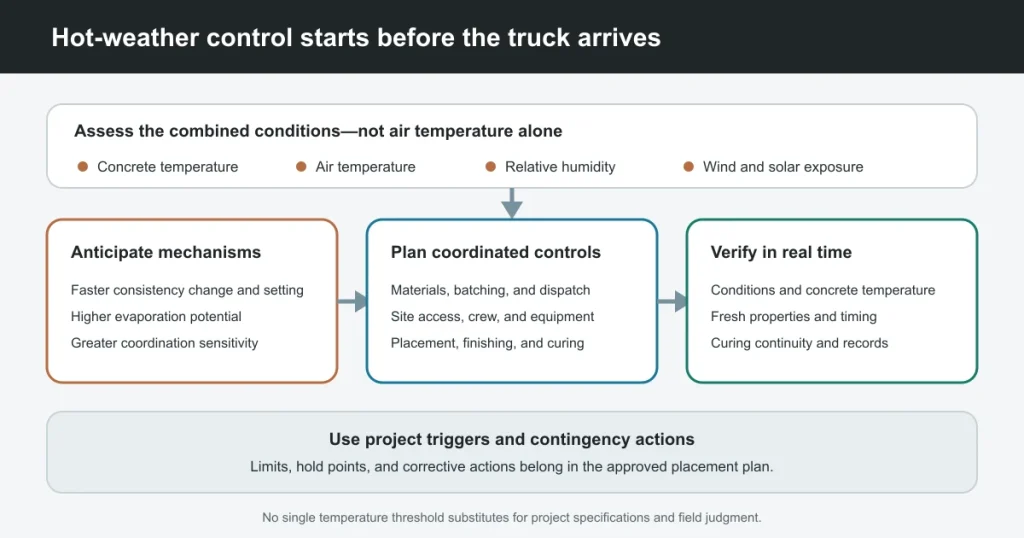
Hot-weather concreting is not defined by air temperature alone. It results from interacting factors: ambient temperature, concrete temperature, relative humidity, wind speed, and solar radiation. Their combined effect can change during production, transport, placement, finishing, and early curing.
A dry, windy period can create serious surface-drying risk even when the air temperature is not at a seasonal high. Conversely, air temperature alone does not predict concrete temperature, moisture loss, setting, or outcome. A sound plan uses observed conditions and mixture response rather than a calendar date or single thermometer reading.
Guidance is not the same as a specification
ACI PRC-305-20 is a guide to hot-weather concrete practice. It discusses planning, materials, mixture proportions, production, transport, placement, curing, testing, and inspection. Guidance helps the project team identify risks and possible controls, but it does not automatically create project acceptance limits.
Enforceable requirements come from the contract documents and any specification they adopt. Where the project invokes a hot-weather specification, review it with the complete project requirements. Resolve conflicts, define responsibilities, and document approved procedures before work begins.
How hot weather changes concrete behavior
Heat can accelerate cement hydration and workability loss. Wind, low humidity, warm materials, and solar exposure can increase moisture loss from exposed surfaces. These processes overlap but are not interchangeable. Slump may decline through hydration, absorption, evaporation, or combined mechanisms; unplanned water does not identify or correct the cause.
The main risk pathways are summarized below.
| Driver or condition | Immediate mechanism | Potential consequence | What to observe or measure |
|---|---|---|---|
| Warm concrete constituents or equipment | Higher concrete temperature and faster early reactions | Faster consistency loss, shorter placement or finishing window, changed setting behavior | Ingredient and fresh-concrete temperature, elapsed time, consistency trend, setting observations |
| Warm, dry, or windy exposure | Faster moisture loss from the surface | Plastic-shrinkage cracking risk, crusting, finishing difficulty, curing interruption | Weather trend, surface condition, evaporation assessment under the governing procedure |
| Direct solar radiation | Heating of materials, equipment, forms, reinforcement, and concrete surfaces | Local temperature differences, rapid surface drying, variable placement response | Shade and exposure conditions, surface and concrete temperatures where relevant |
| Delayed or interrupted operations | More elapsed time before discharge, consolidation, finishing, or protection | Workability loss, poor consolidation, cold-joint risk, surface defects | Batch, arrival, discharge, placement, finishing, and curing-start times |
| Uncontrolled field adjustment | Change in water content or admixture system without an approved procedure | Altered water-to-cementitious materials ratio, air, setting, stability, strength, or durability | Batch ticket, authorized adjustments, quantities, mixing, and retest results |
| Inadequate early protection | Moisture and temperature conditions depart from the curing plan | Incomplete hydration near the surface, cracking, variable color or texture, reduced durability potential | Time to protection, continuity of curing, surface condition, interruptions |
This table is a diagnostic map, not a set of automatic cause-and-effect guarantees. The severity of each consequence depends on the mixture and the actual construction sequence.
Effects on fresh concrete
Consistency and placement window
As concrete temperature rises, slump or other measures of consistency may change more quickly. The crew can have less time for discharge, pumping, consolidation, strike-off, and finishing. A mixture that performs acceptably at the plant may behave differently after transport or when exposed in a pump line, bucket, form, or slab.
Consistency loss should be evaluated as a time-dependent property. An initial test alone may not describe conditions at the point of placement. Planned trials can compare the required response at relevant stages using the actual materials, mixing sequence, equipment, and anticipated weather range.
Setting, finishing, and continuity
Faster setting can narrow the interval in which adjacent lifts or placements can be integrated. If delivery, labor, equipment, or placement rate becomes inconsistent, the likelihood of lift lines, finishing problems, or unintended construction joints may increase. Early surface stiffening can also tempt crews to finish prematurely or apply water to the surface, practices that can damage the near-surface zone.
Air, stability, and test variability
Temperature, mixing, elapsed time, and admixture interactions may influence air content, bleeding, stability, and finishability. The response is mixture-specific, so qualification should consider more than slump and compressive strength. Air content, density, yield, visual stability, placement response, and finishing may also be relevant.
Early-age risks
Plastic-shrinkage cracking
Plastic-shrinkage risk develops when moisture is lost from the exposed surface while the concrete is still plastic and before it can resist the resulting strain. Wind, low humidity, solar heating, and concrete temperature all matter. The critical condition can occur before, during, or shortly after placement and can change quickly across the site.
An evaporation estimate can support planning when the governing procedure calls for it, but it should not be treated as a complete prediction. Local exposure, shading, member geometry, bleeding behavior, and the timing and effectiveness of protection also affect the outcome.
Thermal and restrained volume change
Concrete heats and cools while strength and stiffness are developing. Temperature differences within a member or between the concrete and its surroundings can create differential volume change. Restraint from the member itself, reinforcement, foundations, adjacent placements, or geometry may convert that movement into tensile stress.
Hot weather does not make every placement a thermal-cracking problem, and no control suits every member. Assess placement temperature, heat development, dimensions, boundary conditions, cooling exposure, restraint, and the significance of cracking.
Curing vulnerability
Early moisture loss can interrupt the environment needed for hydration, particularly near exposed surfaces. A delay between finishing and effective curing, gaps in wet curing, loose coverings, or loss of curing material can create nonuniform surface conditions. Curing should be planned as a continuous operation with materials, labor, inspection, and backup measures available before placement starts.
Effects on hardened concrete
Warm curing conditions can accelerate early strength development, but faster early strength does not guarantee equal later-age performance. The final result depends on mixture proportions, water content, temperature history, moisture availability, specimen handling, and test age. Field concrete and acceptance specimens can also experience different temperature and curing histories.
Durability may be affected indirectly when operations lead to unplanned water addition, inadequate consolidation, cracking, or incomplete curing. These pathways can increase permeability or create routes for moisture and aggressive agents. Surface crusting, nonuniform drying, and inconsistent curing may also produce variable texture or color.
These outcomes are risks, not universal predictions. Project records and appropriate testing are needed to distinguish a material problem from production, placement, curing, sampling, or specimen-conditioning effects.
Risk-based hot-weather control checklist
The checklist below is a framework for a project-specific plan. Each selected control should identify the responsible person, trigger for use, method, verification record, and fallback action.
Planning
- Review the contract documents, current referenced standards, approved mixture, submittals, and responsibilities for hot-weather decisions.
- Assess expected ambient conditions together with concrete temperature, humidity, wind, solar exposure, member geometry, placement rate, and access.
- Identify critical operations and handoffs from batching through curing; include realistic delays, equipment changes, and interruption scenarios.
- Define project-specific action levels and acceptance criteria through the responsible design, construction, testing, and concrete-supply parties.
- Conduct representative laboratory or production trials where needed to verify consistency retention, setting, air, stability, finishing, strength, and other required properties.
- Approve communication, stop-work, rejection, adjustment, and restart procedures before the placement.
- Prepare the worker heat-safety plan as a separate but coordinated workstream.
Production
- Confirm stockpile, water, cementitious-material, admixture, equipment, and plant conditions that may affect concrete temperature or uniformity.
- Evaluate suitable temperature-control options with the producer and responsible parties; verify that selected methods are compatible with the mixture and plant.
- Check aggregate moisture and apply traceable batch-water corrections under the approved quality-control procedure.
- Verify admixture storage, dispensing, dosage basis, addition sequence, and mixing requirements against current manufacturer instructions and trial results.
- Monitor batch uniformity and fresh properties at the frequency required by the project.
- Record material-source, mixture, sequence, or equipment changes that could invalidate prior trials.
Transport and delivery
- Coordinate dispatch rate with actual placement capacity so trucks do not accumulate or leave the crew waiting.
- Track batch, arrival, test, discharge, and placement times using a consistent record.
- Anticipate traffic, pump setup, access, washout, and equipment-failure contingencies.
- Keep delivery equipment in the condition required by the approved plan and avoid unnecessary exposure or delay.
- Apply only authorized jobsite adjustments; record the quantity, time, approval, mixing, and verification tests.
- Escalate changing consistency, temperature, air, stability, or delay trends before they become repeated nonconformances.
Placement and finishing
- Confirm that forms, reinforcement, subgrade, embedded items, pumps, tools, labor, and protection materials are ready before concrete arrives.
- Evaluate shade, wind protection, work sequencing, and placement timing where these are practical and approved.
- Match the placement rate to consolidation and finishing capacity while maintaining planned continuity.
- Observe the surface for rapid drying, crusting, loss of sheen, plastic cracking, or differences between exposed and protected areas.
- Do not use unauthorized water addition, surface water, or improvised admixture dosing to restore workability or aid finishing.
- If a delay or interruption occurs, follow the approved joint, disposition, or restart procedure rather than concealing the discontinuity.
Curing and protection
- Have the approved curing system, backup supplies, labor, and inspection method on site before discharge begins.
- Coordinate interim evaporation protection, final finishing, and the start of curing so the surface is not left unprotected.
- Maintain continuity and coverage of the approved curing method, including edges, corners, repairs, and areas disturbed by traffic or later work.
- Check coverings, water supply, curing application, and protective barriers throughout the required project period.
- Manage temperature changes and removal of protection in accordance with the project plan, particularly where geometry or restraint raises thermal risk.
- Document interruptions, damaged protection, rapid drying, cracking, or surface anomalies and obtain a disposition when required.
Verification and records
- Measure fresh-concrete temperature using the current project-specified test method, such as ASTM C1064/C1064M where applicable.
- Record the time and location of each measurement; a fresh-concrete temperature result represents the concrete at the time of testing and does not describe its entire later temperature history.
- Record weather observations at representative locations and times under the project procedure.
- Link batch tickets, adjustments, fresh-property tests, specimen identification, placement locations, curing records, and nonconformance reports.
- Protect acceptance specimens from unplanned environmental exposure and distinguish standard-cured from field-cured specimens.
- Review trends during the work rather than waiting for later strength results to reveal a recurring process problem.
Worker heat exposure requires its own controls
Concrete-quality controls do not replace worker protection. OSHA identifies heat exposure as a workplace hazard affected by environmental conditions, workload, clothing or personal protective equipment, and worker factors. The site safety program should address acclimatization, water, rest, shade or cooling, work scheduling, training, supervision, and emergency response as applicable.
Quality and safety plans should be coordinated because schedule changes, shade structures, protective clothing, rest cycles, and staffing can affect placement capacity. Safety requirements govern the work; a concrete-quality target is not a reason to bypass them.
Common planning errors
Several shortcuts weaken a hot-weather plan:
- defining hot weather by air temperature alone;
- copying a temperature, evaporation, transport, or curing limit without checking the governing project documents;
- relying on an initial slump or temperature test to represent the entire placement;
- treating water addition as the default response to consistency loss;
- selecting an admixture or cooling method without compatibility and production-scale verification;
- starting curing materials or labor arrangements after finishing begins; and
- keeping weather, batch, testing, placement, and curing records in disconnected systems.
A better approach is to connect each observed risk to an authorized control and a verifiable record. This makes the plan adaptable without making it arbitrary.
Frequently asked questions
Is hot-weather concreting defined by air temperature alone?
No. The assessment should consider ambient and concrete temperatures, relative humidity, wind, solar exposure, elapsed time, and the response of the actual concrete mixture throughout production, placement, finishing, and early curing.
How can hot weather affect fresh concrete?
Hot-weather conditions can accelerate consistency loss and setting, shorten the placement and finishing window, increase surface drying, and influence air content, bleeding, stability, and finishability. The severity is mixture- and process-specific.
Does an evaporation estimate fully predict plastic-shrinkage cracking?
No. It can support planning under the governing procedure, but local exposure, shading, member geometry, bleeding behavior, and the timing and effectiveness of surface protection also affect risk.
Should water be added whenever concrete loses slump in hot weather?
No. Consistency loss can result from hydration, absorption, evaporation, elapsed time, or combined causes. Any permitted adjustment must be authorized, measured, recorded, mixed, and verified under the approved procedure.
What should a hot-weather concrete control plan include?
It should connect pre-placement risk assessment, representative trials, material and concrete temperature control, dispatch and placement coordination, curing readiness, real-time observations, traceable records, and approved escalation or disposition procedures.
Conclusion
Hot-weather concrete is a systems problem. Ambient conditions, concrete temperature, materials, time, equipment, geometry, workmanship, and early protection act together. The practical objective is not to find one universal threshold; it is to recognize the active mechanisms, prepare proportionate controls, and verify that the concrete delivered and placed meets the project requirements.
A reliable plan begins before batching, follows the concrete through placement and early curing, and preserves evidence to evaluate the result. When conditions or behavior leave the qualified operating window, use the approved escalation and disposition process.
Engineering references
American Concrete Institute, Hot Weather Concrete Resources:
https://www.concrete.org/newsandevents/news/newsdetail.aspx?f=51748932American Concrete Institute, ACI PRC-305-20: Guide to Hot Weather Concreting:
https://www.concrete.org/store/productdetail.aspx?Format=PROTECTED_PDF&ItemID=30520&Language=English&Units=US_UnitsAmerican Concrete Institute, ACI 305R-20 Preview:
https://www.concrete.org/Portals/0/Files/PDF/Previews/305R-20_preview.pdfNational Ready Mixed Concrete Association, CIP 12: Hot Weather Concreting:
https://www.nrmca.org/wp-content/uploads/2021/01/12pr.pdfASTM International, ASTM C1064/C1064M-23: Standard Test Method for Temperature of Freshly Mixed Hydraulic-Cement Concrete:
https://store.astm.org/c1064_c1064m-23.htmlOccupational Safety and Health Administration, Heat Exposure:
https://www.osha.gov/heat-exposure